
Country Information


Country Information
Argentina
Belarus
Brazil
China
Cuba
Egypt
France
India
Iran
Iraq
Israel
Japan
Kazakhstan
Libya
North Korea
Pakistan
Russia
South Africa
South Korea
Syria
United Kingdom
USA
Ukraine
Uzbekistan
Yugoslavia
Other

Advanced Search


Search for:


Enter query terms separated by spaces.
Match:
Search in: Select any one of the following databases and archives or search any combination.
Click here for more details.
Entire Web Site
Global Security Newswire
CBW & WMD Terrorism Archive
Country Profiles
WMD 411
Issue Briefs & Analysis
Securing the Bomb
NTI Press Room
Source Documents
HEU Reduction and Elimination Database
Submarine Proliferation Database
Russian Language Resources
NIS Nuclear Trafficking Database
Brazil
Submarine

Updated May 2008

Introduction
redline

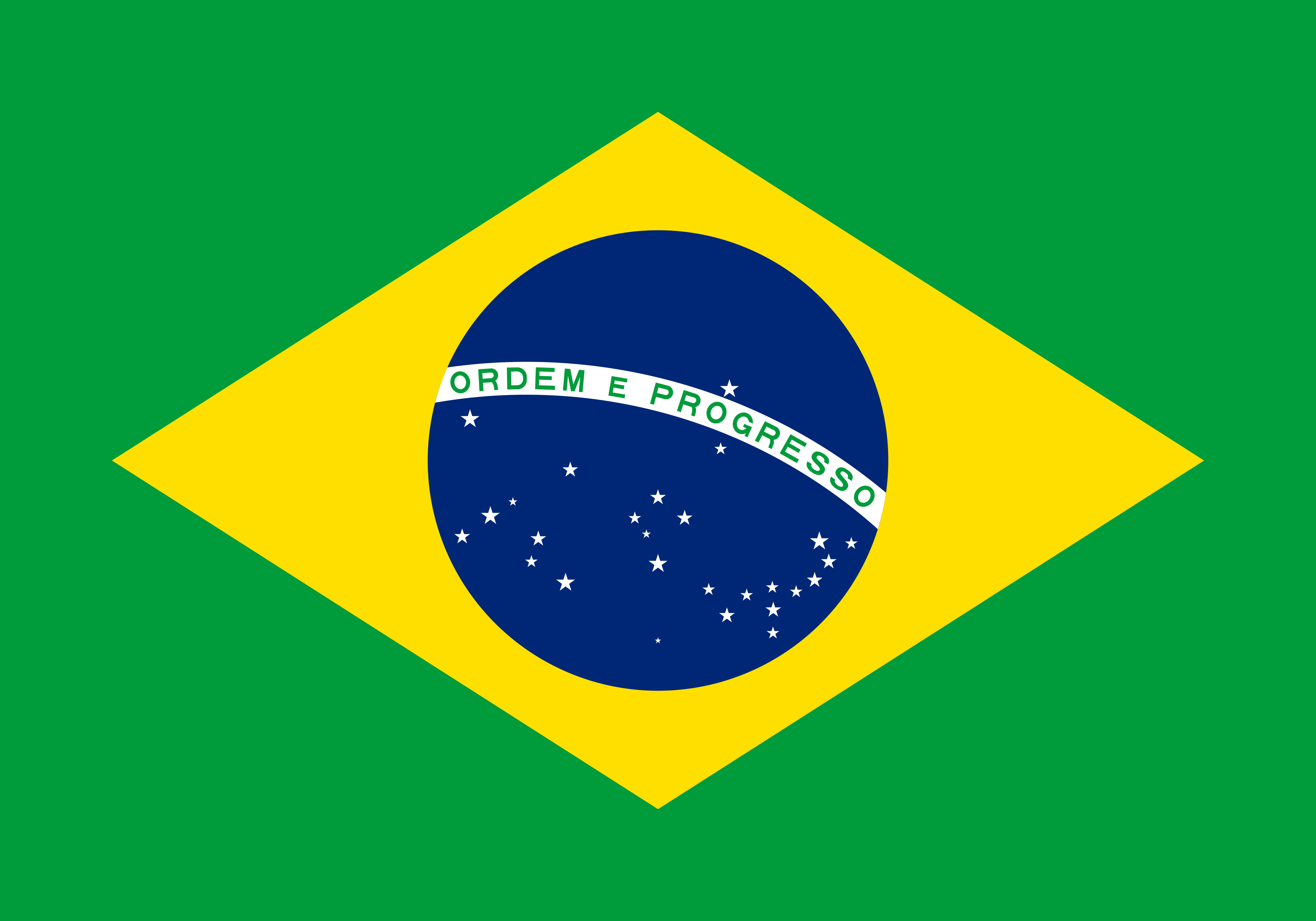
Brazil has abjured nuclear, biological, and chemical weapons, and curtailed its ballistic missile program in the early 1990s. From the 1970s to the early 1990s, however, Brazil’s nuclear program aroused concern that the country was seeking to develop nuclear weapons. The international community—and Washington in particular—raised additional concerns that technology from Brazil’s space launch vehicle program would be used for production of ballistic missiles. Brasilia is now a member of all key international nonproliferation regimes.
на русском (in Russian)

Nuclear

From the 1960s to the early 1990s, Brazil pursued an ambitious program of nuclear energy and technological development, which included construction of an unsafeguarded uranium enrichment facility under Navy direction. However, Brazil has since disavowed nuclear weapons, become a State Party to the Treaty on the Non-Proliferation of Nuclear Weapons (NPT), and, with Argentina, established a bilateral inspection agency to verify both countries' pledges to use atomic energy only for peaceful purposes. . Currently, Brazil mines uranium and ships it to Canada for conversion and to Europe for enrichment. When it returns in the form of gas, it is fabricated in Resende (in the state of Rio de Janeiro) into fuel for its two nuclear power reactors. When completed, a uranium enrichment plant under construction in Resende will allow the country to make its own low-enriched uranium fuel for its nuclear power industry. The plant initially will produce 60 percent of the nuclear fuel used by Brazil's two operational nuclear power reactors (Angra 1 and Angra 2). The government conducted an unveiling ceremony of the uranium enrichment plant in early May 2006 and expects that by 2012 the plant will be able to meet 100% of the needs for the two units and by 2014 it will be able to supply all the reactors, including a third nuclear plant under construction (Angra 3). The government of Brazil is considering the possibility of signing an Additional Protocol with the IAEA which would allow for more intrusive inspections of the country's facilities that use nuclear material.

In 2008 Brazil and Argentina signed a nuclear cooperation agreement which envisages the creation of a new binational uranium enrichment company, the development of a nuclear reactor to provide energy for both countries, and the joint assembly of a nuclear submarine.

Biological

There is no evidence that Brazil has ever developed or produced biological weapons. It ratified the Biological and Toxin Weapons Convention (BWC) in 1973 and signed the Mendoza Declaration in 1991, which prohibits biological as well as chemical agents. Brazil's opposition to biological weapons is evident from reports that senior government officials oppose using biological agents even to control coca production in neighboring Colombia. Brazil does have the capacity to produce biological agents; for example, it has one of the world’s largest crops of the castor bean (which naturally produces the toxin ricin) and is proficient in advanced biological techniques such as gene sequencing. However, there is no indication that Brazil presents a biological weapons threat; it is, in fact, a staunch proponent of biological weapons nonproliferation.

Chemical

There is no evidence that Brazil has ever embarked on a chemical warfare (CW) program; to the contrary, Brazil is an extremely active participant in CW nonproliferation efforts. Even before the Chemical Weapons Convention (CWC) came into existence, Brazil engaged in regional nonproliferation efforts. For example, in September 1991, Brazil, Argentina, and Chile signed the Mendoza Declaration, which commits signatories not to use, develop, produce, acquire, stock, or transfer—directly or indirectly—chemical or biological weapons. Brazil participated actively in the negotiations for the CWC and ratified it in March 1996, thereby becoming a charter member of the Organisation for the Prohibition of Chemical Weapons (OPCW). By the end of 2000, Brazil had hosted five OPCW inspections of its chemical industry sites, as well as the first simulation of a challenge inspection of private industry.

Missile

Brazil curtailed the military potential of its space launch vehicle (SLV) program in the early 1990s and joined the Missile Technology Control Regime (MTCR). Previously, however, military control over the SLV program and an ambitious export program of short-range rockets had raised concerns that Brazil might develop ballistic missiles and supply other countries with them.

bulletBack to top

bullet About This Section

CNSThis material is produced independently for NTI by the James Martin Center for Nonproliferation Studies at the Monterey Institute of International Studies and does not necessarily reflect the opinions of and has not been independently verified by NTI or its directors, officers, employees, agents. Copyright © 2008 by MIIS.

Get the factsGet informedGet involved