
Back to Country Index COUNTRY PROFILE
Biological
Access Newswire
Country Information
 
Introduction

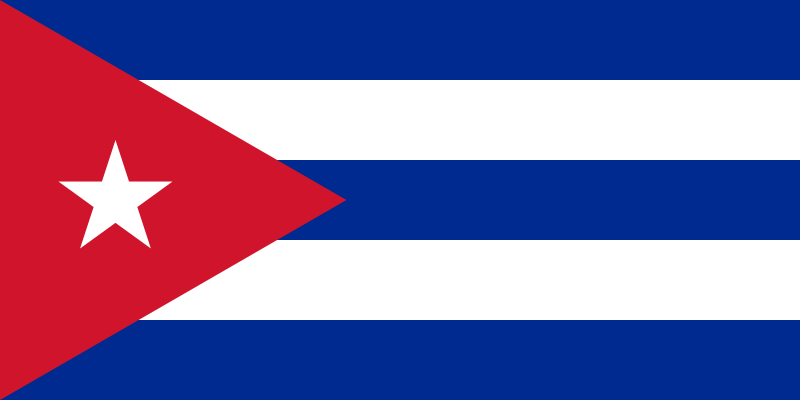
Fidel Castro spearheaded Cuba's communist revolution by leading a rebel army to victory in 1959. Relations between Washington and Havana deteriorated rapidly; the United States imposed an embargo on Cuba in October 1960 (which is still in effect today) and broke diplomatic relations in January 1961. Taking advantage of Cuba's fear of U.S. armed aggression against the island, the Soviets persuaded Cuba into adopting closer economic and political ties, including military and defense arrangements; later that year, Castro formally embraced Marxism. Tensions between the United States and Cuba peaked during the October 1962 missile crisis.

Under Castro, Cuba became a highly militarized society. Massive Soviet military assistance enabled Cuba to upgrade its military capabilities and expand its military presence abroad, spending millions of dollars in exporting revolutions, most visibly in Angola, Ethiopia, and Nicaragua. Cuba's support for these guerrilla movements, its Marxist-Leninist government, and its alignment with the USSR led to its isolation in the hemisphere.

Cuba does not possess nuclear weapons, and there are no credible reports of Cuban efforts to acquire nuclear weapons. In 2002, Havana acceded to the Treaty on the Non-Proliferation of Nuclear Weapons (NPT), ratified the Treaty for the Prohibition of Nuclear Weapons in Latin America and the Caribbean (Treaty of Tlatelolco), and has an Additional Protocol with the IAEA. Cuba is not reported to possess chemical weapons (it acceded to the Chemical Weapons Convention [CWC] in 1993), nor are there credible reports of Cuban possession of long-range ballistic missiles. Cuba has been suspected of having a program of research on biological warfare (BW) agents, though the existence, scope and focus of this effort remains obscure and controversial. Since the 1990s, U.S. administrations have determined that Cuba possesses the capability to launch a limited offensive biological weapons program and has provided dual-use biotechnology to other nations—suspicions that stem from Cuba's possession of one of the most advanced biomedical industries in Latin America and its large-scale production of pharmaceuticals and vaccines. In 2002, the George W. Bush administration claimed that Cuba was in fact developing BW agents, although no evidence was provided. Cuba, which vehemently denies the American claims, has been a member of the Biological and Toxin Weapons Convention (BTWC) since 1976.

In 1990, Cuba's Air Force, with about 150 Soviet-supplied fighters, including advanced MiG-23 Floggers and MiG-29 Fulcrums, was probably the best equipped in Latin America. In 1994, Cuba's armed forces were estimated to have 235,000 active duty personnel. Cuban military power has been sharply reduced by the loss of Soviet subsidies. By 1999, the Revolutionary Armed Forces numbered about 60,000 regular troops.


See Cuba Biological Weapons Profile
 
 Oct. 26, 2007
 Oct. 26, 2007
 Mar. 17, 2005
 Feb. 13, 2004


Updated October 2007


Treaties and Organizations
Cuba Special Weapons, FAS
Cuba's Pursuit of Biological Weapons: Fact or Fiction?
Cuba Bioweapons: Threat or Political Punching Bag?
U.S. Says Cuba Has Limited Germ Weapons Effort
CIA World Fact Book
GlobalSecurity: Cuba
CUBA & NON-PROLIFERATION REGIMES


Search for:


Enter query terms separated by spaces.
Match:
Search in: Select any one of the following databases and archives or search any combination.
Click here for more details.
Entire Web Site
Global Security Newswire
Country Profiles
WMD 411
Issue Briefs & Analysis
Securing the Bomb
NTI Press Room
Source Documents
HEU Reduction and Elimination Database
Submarine Proliferation Database
Russian Language Resources
NIS Nuclear and Missile Database
NIS Nuclear Trafficking Database

Country Information
Argentina
Belarus
Brazil
China
Cuba
Egypt
France
India
Iran
Iraq
Israel
Japan
Kazakhstan
Libya
North Korea
Pakistan
Russia
South Africa
South Korea
Syria
United Kingdom
United States
Ukraine
Uzbekistan
Yugoslavia
Other


Research Library
Country Information Glossary
Issues & Analysis Source Documents
Databases Warheads & Materials
 

back to top

About This Section  CNS Experts 

CNSThis material is produced independently for NTI by the James Martin Center for Nonproliferation Studies at the Monterey Institute of International Studies and does not necessarily reflect the opinions of and has not been independently verified by NTI or its directors, officers, employees, agents. Copyright © 2007 by MIIS.

HOME   | CONTACT US   | GET INVOLVED   | SITE MAP