
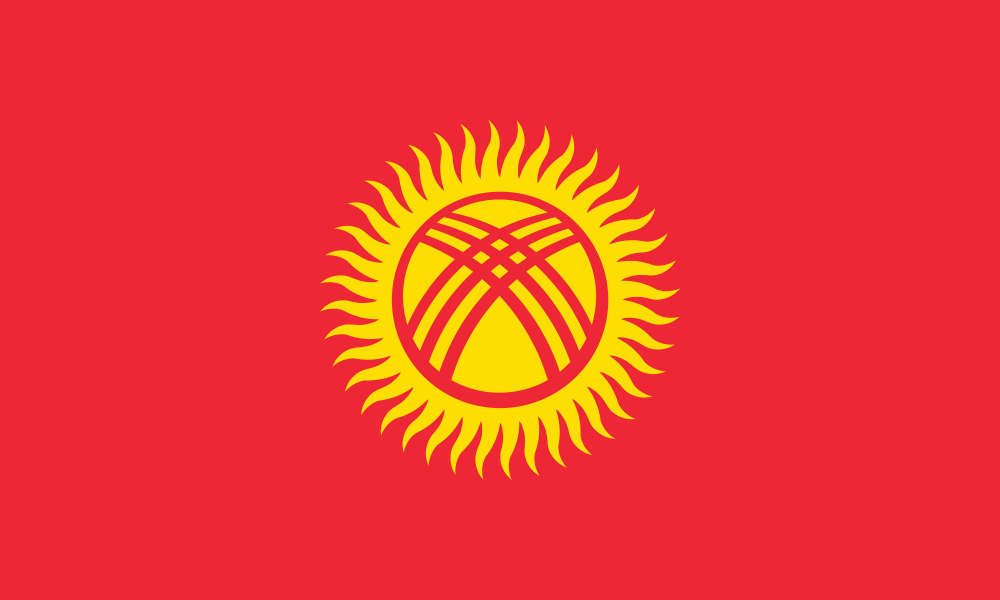
Back to Country Index COUNTRY PROFILE
Nuclear Biological
Access Newswire
Country Information
 
Introduction


The smallest and second-least populated of the five former Soviet Central Asian states, mountainous Kyrgyzstan inherited a large uranium mining and milling complex and several military-related industrial facilities when the Soviet Union broke apart. Much of the remaining military industrial complex has either gone bankrupt, been converted to civilian use, or has reverted to Russian management. The main proliferation threat posed by Kyrgyzstan is its location near countries that possess nuclear and other WMD-related materials, namely Russia and Kazakhstan, and countries to its south that are allegedly seeking these materials. Kyrgyzstan also must deal with uranium tailings,a legacy of its once-bustling uranium industry, that are dangerously close to large population centers.
на русском (in Russian)

 
 Dec. 7, 2007
 Jul. 13, 2007
 Feb. 15, 2007
 Sep. 8, 2006

Nuclear
From the 1950s to the 1990s, the Kara-Balta Ore Mining Combine in northern Kyrgyzstan processed uranium concentrate from deposits in both Kyrgyzstan and Kazakhstan for use in the Soviet Union's military and civilian nuclear industries.  Kara-Balta stopped processing Kazakhstani uranium concentrate into U3O8 in 2005. Uranium extraction in Kyrgyzstan itself has ceased. Radioactive waste in uranium tailings ponds in Kyrgyzstan poses a significant health threat.  The European Union, Russia, and the United States have provided foreign assistance to help Kyrgyzstan come up with solutions to its uranium waste problem. Kyrgyzstan is party to the Nuclear Non-Proliferation Treaty (NPT) and the Comprehensive Test Ban Treaty (CTBT) and has an Additional Protocol with the International Atomic Energy Agency (IAEA).  The foreign ministers of the five Central Asian States--Kazakhstan, Krygyzstan, Tajikistan, Turkmenistan, and Uzbekistan--signed a treaty establishing a Central Asian Nuclear Weapon Free Zone (CANWFZ) on 8 September 2006. 
 
See Kyrgyzstan Nuclear Profile

Biological
Kyrgyzstan acceded to the Biological and Toxin Weapons Convention (BWC) in October 2004. There is no evidence that it possesses or seeks biological weapons.
 
See Kyrgyzstan Biological Profile

Chemical
Kyrgyzstan signed and ratified the Chemical Weapons Convention (CWC) in February and October 2003, respectively. Bishkek neither possesses nor pursues chemical weapons.
 

Missile
The Dastan facility in Bishkek, which produces Shkval torpedoes and self-guidance and control systems, is the largest missile-related production facility in Kyrgyzstan. In November 2004, the Kyrgyzstani parliament voted to sell the state share in Dastan to Russian companies, including Rosoboronexport. The facility would reportedly produce torpedoes for the export market.


Updated January 2008


Kyrgyzstan Maps
Central Asian NWFZ
WMD in Central Asia
Export Control Developments
NIS Nuclear Trafficking Database
Full-Text Documents
IAEA Factsheet: Kyrgyzstan
Kyrgyzstan Government Website
CIA World Factbook: Kyrgyzstan
Center on Export Controls
Central Asia: Regional Security and WMD Proliferation Threats (UNIDIR)


Search for:


Enter query terms separated by spaces.
Match:
Search in: Select any one of the following databases and archives or search any combination.
Click here for more details.
Entire Web Site
Global Security Newswire
Country Profiles
WMD 411
Issue Briefs & Analysis
Securing the Bomb
NTI Press Room
Source Documents
HEU Reduction and Elimination Database
Submarine Proliferation Database
Russian Language Resources
NIS Nuclear and Missile Database
NIS Nuclear Trafficking Database

Country Information
Argentina
Belarus
Brazil
China
Cuba
Egypt
France
India
Iran
Iraq
Israel
Japan
Kazakhstan
Libya
North Korea
Pakistan
Russia
South Africa
South Korea
Syria
United Kingdom
United States
Ukraine
Uzbekistan
Yugoslavia
Other


Research Library
Country Information Glossary
Issues & Analysis Source Documents
Databases Warheads & Materials
 

back to top

About This Section  CNS Experts 

CNSThis material is produced independently for NTI by the James Martin Center for Nonproliferation Studies at the Monterey Institute of International Studies and does not necessarily reflect the opinions of and has not been independently verified by NTI or its directors, officers, employees, agents. Copyright © 2007 by MIIS.

HOME   | CONTACT US   | GET INVOLVED   | SITE MAP