
A Conflict in Space Could Go Nuclear. It Doesn’t Have To.
No major power has an interest in an unintended nuclear war. Weapons are now in orbit. The guardrails are not. The time to build them is before a crisis, not during one.
This post was written by Kathryn Sohm, an intern with NTI's Communications team. Sohm will graduate in 2021 from the College of Saint Benedict with a major in English and minors in Political Science and Art.
In a democracy, almost every governmental process is subject to checks and balances to ensure that too much power doesn’t rest with one person or one branch of government. However, when it comes to one of humanity’s greatest threats—nuclear annihilation—the president can order a nuclear strike at a moment’s notice, without review or second opinion. That puts us just a push of a button away from nuclear war.
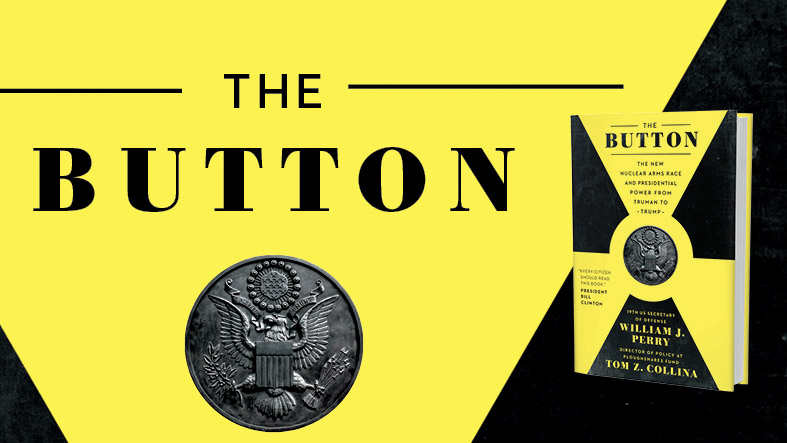
The risks posed by this policy governing nuclear launch authority were discussed this week during a virtual book launch hosted by NTI of The Button: The New Nuclear Arms Race and Presidential Power from Truman to Trump by William J. Perry and Tom Collina. The authors were introduced by NTI Co-Chair Sam Nunn, and the discussion was moderated by longtime foreign policy journalist Carol Giacomo, who recently retired from the New York Times editorial board.
The book explores the history of nuclear launch authority and the growing nuclear risks that threaten our world. Perry, an NTI emeritus board member who served as the United States’ 19th Secretary for Defense, and Collina, director of policy at Ploughshares Fund, discussed three questions posed by Nunn:
“If you want to understand how fortunate our world has been to avoid nuclear catastrophe—take a deep breath and read the hair-raising stories Bill and Tom recount in The Button,” Nunn told the crowd on the June 23 webinar. “I urge you to consider carefully their recommendations for our nation’s security.”
The authors said that U.S. nuclear policy is currently focused on the wrong threats, driven by a massive defense industry and 75 years of outdated thinking since the first nuclear test, followed by the bombings of Hiroshima and Nagasaki, in the summer of 1945.
Keeping land-based intercontinental ballistic missiles (ICBMs) on alert is an accident waiting to happen, they said, particularly at a time when the real danger is of nuclear use due to blunder or miscalculation, rather than an intentional Russian first strike. False alarms are not unheard of—there already have been six—and at any moment, nuclear weapons could be launched based on false information. They also argued that the increasing U.S. focus on competition with China could prompt Beijing to build up its nuclear arsenal.
Collina said the upcoming anniversaries of the Trinity test and the bombings in Japan, as well as the presidential election in November, create “an historic opportunity to debate the future of nuclear policy.”
In the book, he and Perry offer a set of solutions to lessen the likelihood of both deliberate and accidental nuclear attacks. They recommend ending presidential sole authority and requiring secondary approval—acknowledging that this is not likely to happen without a change in administrations. They also support a prohibition on “first-use” of nuclear weapons, only allowing nuclear weapons to be launched once another country has done so. Lastly, they call for phasing out ICBMs, a move that would reduce risk and save money for the government at a time when the nation is facing a pandemic and serious economic downturn, Collina said.
“You don’t have to think like Dr. Strangelove to understand The Button,” Nunn said. “You don’t have to be a Cassandra to recognize that the growing nuclear risks explained by Dr. Perry and Tom Collina demand rational and wise national and global leadership.”
Watch the video of the webinar here.
Sign up for our newsletter to get the latest on nuclear and biological threats.
No major power has an interest in an unintended nuclear war. Weapons are now in orbit. The guardrails are not. The time to build them is before a crisis, not during one.

The integration of AI into nuclear systems is underway. The guardrails, safety, and security frameworks needed to understand and manage the consequences are not. A new generation of AI-informed nuclear fail-safe reviews is urgently needed in all countries with nuclear weapons.

Congress’s oversight of U.S. nuclear policy is at a critical juncture. When the U.S. Senate approved New START in 2010, it mandated several annual reports and certifications to ensure strong congressional oversight of Russian compliance with the treaty. These requirements expired along with the treaty, creating oversight gaps just as strategic competition heats up.
Sign up for regular updates on innovative, real-world solutions to existential threats.