

Simon Thorpe
Herbert Scoville Jr. Peace Fellow
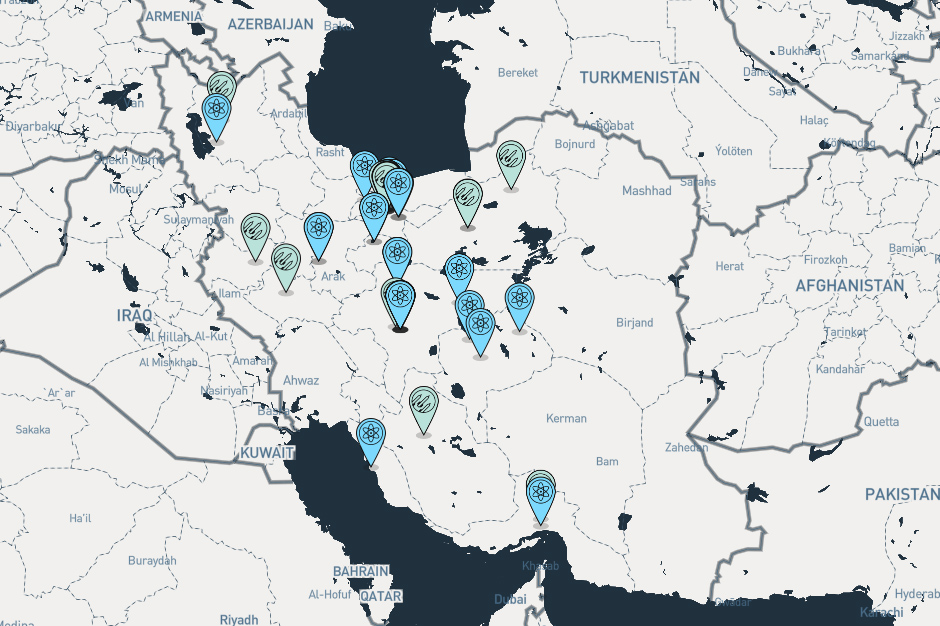
President Trump launched his February 2026 strikes on Iran with the stated purpose of preventing the country from building a nuclear weapon, but as the conflict has unfolded, media coverage has focused on the far-reaching military, geopolitical, and economic consequences. No matter the war’s many disruptive outcomes, the location and status of Iran’s nuclear materials will be a top priority for U.S. policymakers when the shooting stops.
Five weeks into the war, NTI’s President and CEO Christine Wormuth joined experts from NTI’s Nuclear Materials Security Program, Vice President Scott Roecker and Deputy Vice President Eric Brewer, for a webinar that tackled critical questions about the war’s impact on Iran’s nuclear program, implications for international security, and options to mitigate nuclear risks.
Wormuth began by explaining Iran’s nuclear program in the context of the war to date. Iran’s nuclear facilities have not been a primary target of the latest U.S.-Israeli air campaign because the previous June 2025 strikes against Fordow, Natanz, and Isfahan were largely successful in disrupting enrichment and preventing Iranian access to their buried highly enriched uranium (HEU). Yet the continued presence of the material within these sites remains a problem according to Wormuth, “there is a real need, obviously, to make sure that when the shooting stops, the elements of the Iranian nuclear program are…not getting loose and falling into the hands of unknown actors.”
Wormuth, Roecker, and Brewer acknowledged the extreme difficulty of accounting for and securing sensitive material amid the conflict. Within U.S. military circles, there have been discussions of using Special Operations Forces to quickly go in and remove the most sensitive material. But Wormuth, former Secretary of the U.S. Army, explained that such an operation would be “extraordinarily complicated.” Sending U.S. forces hundreds of kilometers inland to retrieve material buried underneath piles of rubble would require significant logistical support and take several days to complete. Although our soldiers are equipped to undertake such difficulties, “it would be very high risk,” she said.
Stressing that the nuclear question cannot be solved with military strikes alone, Roecker questioned whether it would ever be possible to account for all 440 kilograms of Iran’s 60 percent enriched uranium. “You have material that could have been moved to a bunch of different locations…if it’s buried very deep in tunnels, how will we have any confidence that that hasn’t been stolen and isn’t in the black market, available for the highest bidder?” Brewer proposed a scenario in which Iran claims a portion of its HEU was destroyed in the bombings, noting that it would be difficult for observers to determine whether the claim was accurate. Because of these challenges, the panelists affirmed that it was imperative for international inspectors to return to Iran as soon as possible to begin putting the pieces of the puzzle back together.
The three experts agreed that it appears unlikely that the Islamic Republic will fall, but the instability within the country still poses major challenges. With the hardline leaders in Tehran fighting for survival, and no inspections by the International Atomic Energy Agency for almost a year, convincing Iran to forgo nuclear weapons development may be the most difficult challenge of all. Brewer contended that an Iran without any conventional means of defending itself would not hand over its last remaining “bargaining chip.” Leaders of Iran’s Islamic Revolutionary Guard Corps—who appear increasingly to be the decision-makers in Tehran—may categorically reject a nuclear deal because of their lack of trust in Washington and belief that they’ve survived “the worst that the United States and Israel can throw at it.”
Roecker added that any nuclear deal must take into consideration the improvement in Tehran’s enrichment capabilities since the JCPOA; Iranian scientists can now enrich uranium very quickly. Additionally, Wormuth predicts a shift in Tehran’s positioning of its nuclear program, from openly advertising its progress as part of a deterrence strategy to working much more quietly. These developments will further complicate international assessments of Iranian nuclear capabilities and efforts to prevent the country from building a bomb.
Looking ahead, Brewer encouraged U.S. policymakers to approach opportunities for progress pragmatically. “For 10ish years we’ve tried to chase the perfect, and in the process, we may have sacrificed the less than perfect but still acceptable,” said Brewer. “We’ve got to think very deliberately and strategically so we don’t continue to find ourselves in a harder and harder place.”
Sign up for our newsletter to get the latest on nuclear and biological threats.

While countries with existing enrichment capacity may be attracted to laser enrichment as a way to increase the efficiency of their operations, others could be attracted to it as a pathway to a covert weapons program.

For nuclear power to be a problem solver rather than a problem maker, the international community must push for a smart brand of nuclear power that prioritizes safety and security.
One of the most significant achievements in reducing the risk of nuclear terrorism over the past two decades is something that rarely makes headlines.
Sign up for regular updates on innovative, real-world solutions to existential threats.