

Nickolas Roth
Senior Director, Nuclear Materials Security
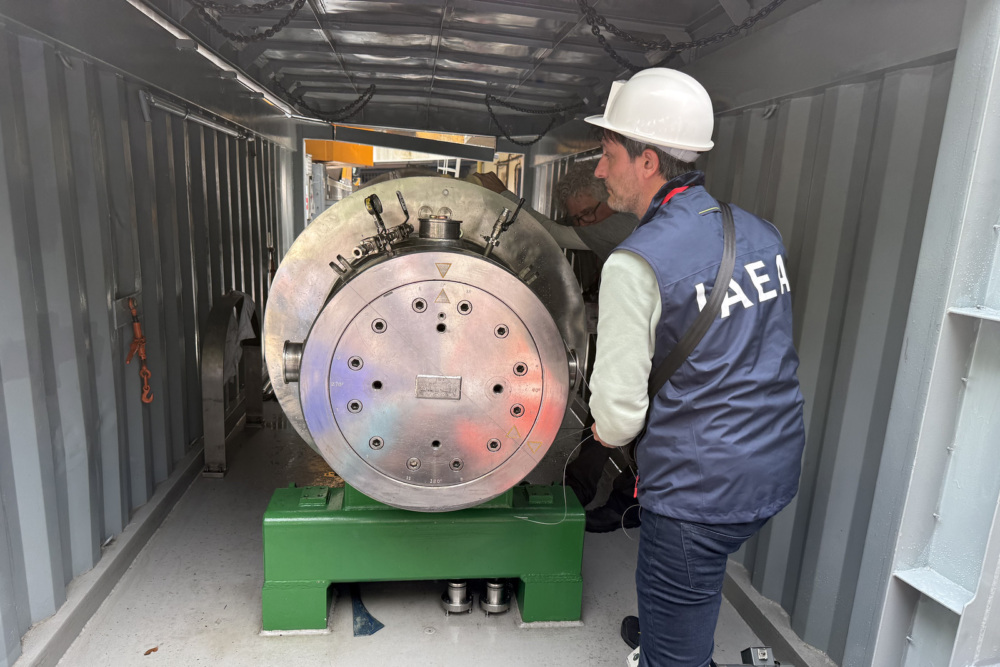
About the image
One of the most significant achievements in reducing the risk of nuclear terrorism over the past two decades is something that rarely makes headlines: the complex, painstaking work of eliminating weapons-usable nuclear material from countries that once held it. Over that period, 25 countries have removed all highly enriched uranium (HEU) or separated plutonium from their borders—representing dozens of facilities that no longer need to be protected against theft, sabotage, or misuse.
The forum that has helped encourage this progress is the International Symposium on HEU Minimization, convened four times by the Norwegian government since 2006. In March 2026, the International Atomic Energy Agency (IAEA) partnered with the Norway to host the symposium’s 20th anniversary meeting, gathering approximately 70 experts, diplomats, and civil society representatives from 20 countries to reflect on the remarkable progress that has been made and the challenges that lie ahead.
Perhaps the most exciting achievement highlighted in the recently released 2026 Chair’s Summary of the meeting is the completion of a goal that earlier symposia aspired to achieve: the conversion of all major producers of molybdenum-99 (the isotope used in millions of medical diagnostic procedures each year) from using HEU to low-enriched uranium (LEU) in their fabrication process. The second symposium, in 2012, recorded political commitments to complete these conversions by 2015. That timeline slipped, but the task was not abandoned. The result is that a global industry that was using approximately 40-50 kilograms of HEU per year at the turn of the century is now using none. That’s more than one bomb a year’s worth of weapons-grade material permanently removed from the civilian nuclear fuel cycle.
This year’s symposium also illustrated how much the underlying debate around HEU minimization has evolved. In 2006, there were questions whether major HEU minimization projects were even technically feasible: could high-performance research reactors and large-scale isotope production facilities operate with LEU fuel? Twenty years later, those have largely been settled. The global research reactor community has demonstrated that the requirements for new high-performance research reactors and industrial-scale radioisotope production can be met with LEU fuel. The discussion has shifted from whether minimization is possible to how to preserve progress and address remaining challenges—like the fact that weapons-usable nuclear material still sits in 24 countries.
Looking ahead, participants identified several areas where attention is needed, including:
At the time of the 2026 Oslo Symposium, it had been eight years since a country last eliminated all of its civilian HEU. Shortly after the meeting’s conclusion, Venezuela—a country not publicly known to possess weapons-usable material—shipped away its remaining HEU. When fellow participants asked me what I hoped to see by the time we next convened, my answer was that I hope it does not take another eight years for the next country to eliminate its HEU.
After two decades, the Oslo Symposium has earned its place in the history of nuclear security as a source of inspiration for one of the field’s clearest success stories. Its value has come from its ability to keep governments engaged and accountable to overcoming barriers that once seemed daunting. The next two decades of progress will require sustained political commitment, technical cooperation, resources, and the continuation of essential international forums, like the Oslo Symposium.
Sign up for our newsletter to get the latest on nuclear and biological threats.
For nuclear power to be a problem solver rather than a problem maker, the international community must push for a smart brand of nuclear power that prioritizes safety and security.

While countries with existing enrichment capacity may be attracted to laser enrichment as a way to increase the efficiency of their operations, others could be attracted to it as a pathway to a covert weapons program.
Convincing Iran to forgo nuclear weapons development may be the most difficult challenge of all.
Sign up for regular updates on innovative, real-world solutions to existential threats.