
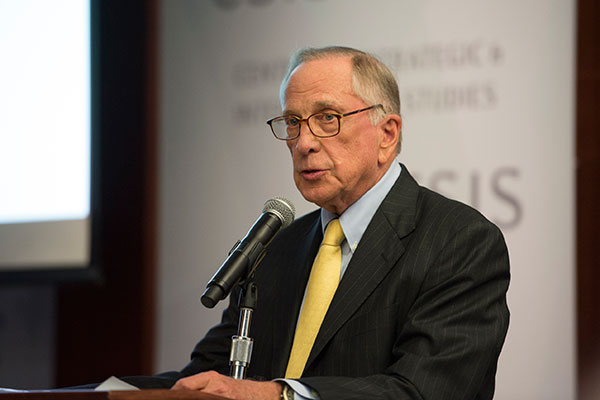
Remarks by Former Senator Sam Nunn at the World Institute for Nuclear Security (WINS) 10th Anniversary
Senator Nunn, NTI Co-Chair, gives remarks at the World Institute for Nuclear Security (WINS) 10th Anniversary event in Vienna, Austria.
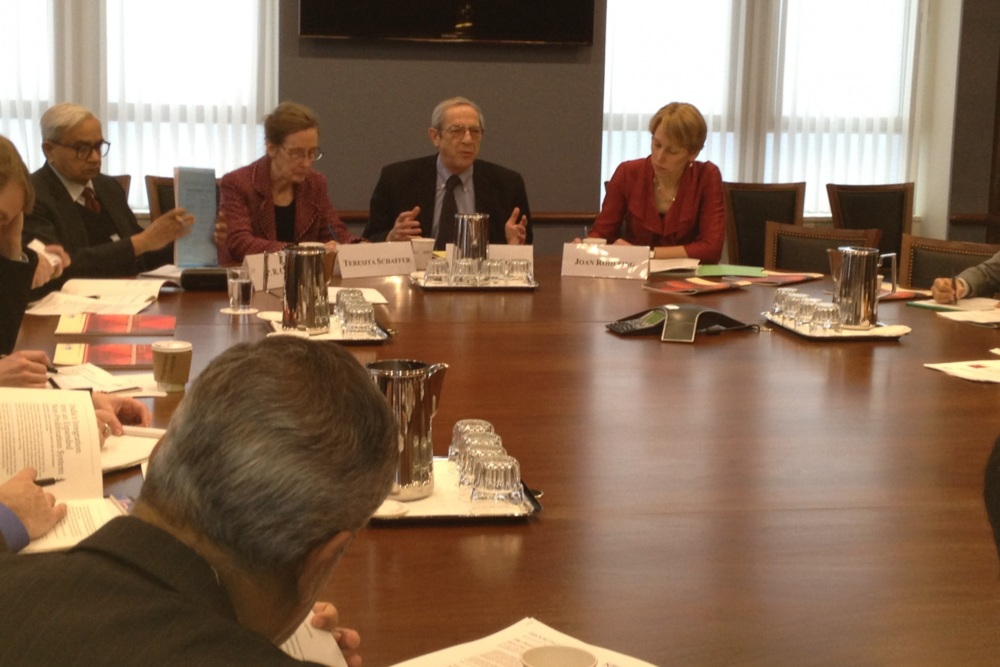
Members included:
From the United States:
Joan Rohlfing, President, Nuclear Threat Initiative
Teresita C. Schaffer, Director, South Asia Program, Center for Strategic and International Studies; former Deputy Assistant Secretary of State for South Asia
Walter Andersen, School of Advanced International Studies, Johns Hopkins University; former State Department official
Lisa Curtis, Senior Research Fellow, Heritage Foundation
Scott Sagan, Caroline S.G. Munro Professor of Political Science and Co-Director, Center for International Security and Cooperation (CISAC), Stanford University
From India:
P. R. Chari, Research Professor, Institute for Peace and Conflict Studies, New Delhi Lalit Mansingh, former Foreign Secretary of India and former Ambassador to the United States
C. Raja Mohan, Strategic Affairs Editor, Indian Express
Lt. General (R) V. Raghavan, Director, Delhi Policy Group
K. C. Singh, former Secretary, Ministry of External Affairs, New Delhi
T.P. Sreenivasan, Former Governor for India of the IAEA, Vienna, and Director General, Kerala International Centre, Trivandrum
M.R. Srinivasan, Former Chairman, Indian Atomic Energy Commission
Senator Nunn, NTI Co-Chair, gives remarks at the World Institute for Nuclear Security (WINS) 10th Anniversary event in Vienna, Austria.
Past Event
Brookings Institution, Washington, DC
The Working Group on an Expanded Nonproliferation System Seeks to Increase Indian participation in the Nonproliferation System
Pete Peterson and Warren Buffet commited to donating a combined $5 million to NTI to support projects to prevent catastrophic nuclear terrorism.
Sign up for regular updates on innovative, real-world solutions to existential threats.