
Jump to search Jump to main navigation Jump to main content Jump to footer navigation

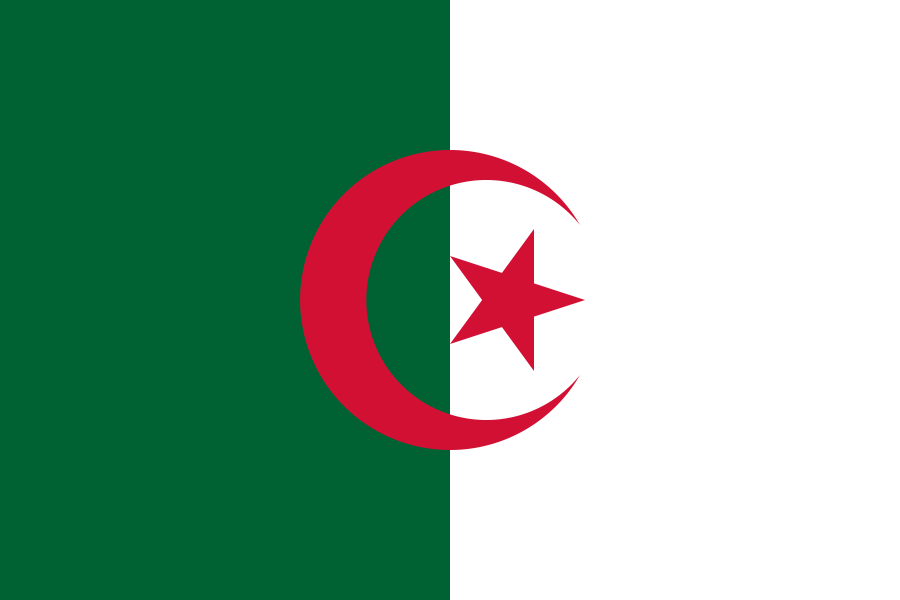
Algeria flagAlgeria

Overview Last updated: March, 2012

Algeria is the only African territory that has served as a base for nuclear weapons testing. During the French occupation (1830-1962), France conducted more than 13 underground nuclear tests in Algeria. In the early 1980s, Algerian authorities demonstrated interest in developing a civilian nuclear program. However, concerns that a military purpose might also be pursued raised doubts in the international community about Algeria's nuclear intentions. Algeria is a state signatory of all major nonproliferation treaties. Its chemical and biological capacities are limited, but the option for Algeria to develop a military nuclear program remains.

Nuclear

Algeria built two nuclear reactors with the assistance of China and Argentina. The first reactor called Nor is located in the city of Draria, Southeast of the Algerian capital Algiers. It was supplied by Argentina in 1985 [1] and was launched in 1989 [2]. Nor uses a small one megawatt thermal reactor fuelled with 20% enriched U-235. Algeria uses this facility for laboratory-scale production of radioisotopes, research in neutron physics, and training of reactor-operating personnel.

The second nuclear reactor, Es Salam, is located near Birin, 250 kilometres south of Algiers.[3] It was provided by the People's Republic of China in 1983 under a secret nuclear agreement.[4] Unlike the Nor reactor, the Es Salam reactor is much bigger in terms of capacity and design. It is a 15 megawatt heavy water reactor that uses low enriched uranium and can produce three to five kilograms of plutonium annually,[5] enough roughly for at least one implosion-type nuclear weapon.[6]

Algeria has sufficient uranium resources to produce nuclear energy. On the southwest border with Niger, there is an estimated 56,000 tons of uranium that could be used to produce nuclear fuel. Between 1971 and 1998, the government undertook many activities to exploit uranium. This led to the discovery of deposits in Eglab, Ougarta and southern Tassili. These results were encouraging. However, between 1998 and 2001, the search effort declined progressively and since then, no real prospecting activity has been pursued.[7]

When Algeria signed its secret nuclear agreements with China and Argentina to build its nuclear facilities, it was not yet a member of the Treaty on the Non-profileration of Nuclear Weapons, which it eventually joined a decade later. It was thought that Algiers wanted to develop a military program in order to gain prestige in North Africa and also to counter the regime of Libya, which had sought to acquire weapons of massive destruction (WMD) for several years. This motivation aroused concerns in neighbouring countries, particularly Spain, Morocco, and Tunisia. However, when U.S. satellites spotted the construction of the Es Salam reactor in the early 1990s, the United States placed great pressure on Algerian authorities, forcing Algiers to accept International Atomic Energy Agency (IAEA) safeguards and join the NPT, which occurred in 1992 and 1995, respectively. During its first inspections, the IAEA discovered three undeclared kilograms of enriched uranium that were supplied by the Chinese government.[8] However, no clandestine nuclear weapons program was detected. Algeria is also a State Party to the Pelindaba treaty. It was one of the first African countries to sign and ratify the treaty.

Currently, Algeria is seeking to develop its nuclear sector with foreign partners who have experience in this field. It signed important nuclear agreements with the United States in June 2007, with France in December 2007, and with Argentina in November 2008.[16] The minister of Energy and Mining announced in November 2009 that the country plans to have its first nuclear power plant in operation by 2020.[17]

Biological

The potential for Algeria to develop a military biological program is very limited. In the 1990s, intelligence agencies of surrounding countries, particularly Spain, suspected that Algeria was undertaking some basic biological development for military purposes. But no strong indication has been proven yet.

Algeria joined the Biological and Toxin Weapons Convention (BTWC) on 22 July 2001. A few months later, Algerian authorities modified their national legislation to harmonize it with the rules of the BTWC. In this regard, Algeria is closely cooperating with the international law enforcement organization Interpol. Within the framework of United Nations Security Council Resolution 1540, the Algerian government is taking appropriate measures to protect its biological laboratories and to thwart terrorist groups from stealing or acquiring biological material.[9] It is also reinforcing its borders to prevent the illegal transfer of bacteriological agents that could be weaponized.[10]

Chemical

There are allegations that the Algerian government used chemical weapons in its fight against terrorism. In May 2006, French press and Algerian human right associations reported that the Algerian army employed toxic gas against members of the Algerian Salafist Group for Call and Combat (GSPC), who were hiding in the caves of the Seddat Mountains.[11] However, no real evidence has surfaced to support these claims. The leader of the GSPC made a statement in which he strongly denounced the offensive, but did not make any reference to the alleged use of chemical weapons.

Algeria ratified the Chemical Weapons Convention (CWC) on 8 August 1995 and is active in the Organization for the Prohibition of Chemical Weapons (OPCW). In June 2007, Algeria hosted a workshop on the CWC to encourage African countries to join the CWC. It was also the occasion for Algeria to celebrate the tenth anniversary of the implementation of the Convention.

Missile

Algeria's missile defense program began a few years after its independence in 1962 and was assisted by the Soviet Union for several years. However, after the collapse of the Soviet state, Algeria maintained its military alliance with Russia while it established new military partnerships with France and the United States.

According to a February 2009 report in the Algerian newspaper El-Khabar, the Algerian military has procured weapons from China, Russia, and Ukraine, including the Russian anti-tank missile Khrizantema, the Russian anti-aircraft missile Pechora-2M, and the anti-tank missile Kornet, in addition to Russian air-to-ground missiles,[12] It is also reported that Algeria has Scud-C rockets with a 600 km range and probably also has the North Korean missile, Nodong with a range of 1000 km.[13]

Sources
[1] "Spain: Intelligence report warns against Algerian nuclear program", Wise News, 25 September 1998 www10.antenna.nl.
[2] "Nur Reactor / Daria", GlobalSecurity.org, www.globalsecurity.org.
[3] "Algeria special weapons", Federation of American Scientist, www.fas.org.
[4] Bill Gertz, "Algeria, China teamed on nukes", The Washigton Times, September 17, 2007, www.washingtontimes.com. See also "The Algerian Nuclear Problem, 1991: Controversy over the Es Salam Nuclear Reactor", The National Security Archives, 10 September 2007, www.gwu.edu.
[5] "Algeria special weapons", Federation of American Scientist, www.fas.org.
[6] Implosion-type weapon don't require enough fissile material. It uses a complex arrangement of explosives to rapidly compress one or more pieces of fissile material into a supercritical mass. For example, the first nuclear weapon ever exploded, at the "Trinity" test near Alamogordo, New Mexico on July 16, 1945, was an implosion-type weapon.
[7] "Nuclear Facilities Profile: Algeria", Stockholm International Peace Research Institute, www.sipri.org. See also, "Uranium 2005: Resources, Production and Demand", A joint report by the OECD Nuclear Energy Agency and the International Atomic Energy Agency, OECD 2005, page 82, www.oecd.org.
[8] "Spain: Intelligence report warns against Algerian nuclear program", GlobalSecurity.org, 23 August 1998 www.globalsecurity.org.
[9] "Step taken by members countries in response to UNSCR 1540", Interpol Website, www.interpol.int.
[10] "Step taken by members countries in response to UNSCR 1540", Interpol Website, www.interpol.int.
[11] "Le massacre de Seddat : les armes chimiques au service de la « lutte antiterroriste ? » ", Algeria-Watch, 31 May 2006, www.algeria-watch.org.
[12] Mohamed Benahmed, "The Army tests news weapons in the heart of the Sahara It received them last year from Russia and Ukraine," El Khabar, 7 February 2009; in Lexis-Nexis Academic Universe.?
[13] "Contre qui l’Algérie s’arme-t-elle? ", [Against whom Algeria is arming?], Maroc Hebdo, www.maroc-hebdo.press.ma.
[14] "Algeria, Argentina Sign Nuclear Deal," 17 November 2008, www.echoroukonline.com
[15] Le Soir d'Algerie, 17 November 2008; "Algeria Planning to Build Country's First Nuclear Power PLant by 2020," in Open Source Document GMP20081118280001.

CNS logo

This material is produced independently for NTI by the James Martin Center for Nonproliferation Studies at the Monterey Institute of International Studies and does not necessarily reflect the opinions of and has not been independently verified by NTI or its directors, officers, employees, or agents. Copyright © 2011 by MIIS.

Get the Facts on Algeria

  • France carried out seventeen nuclear tests in the Algerian desert between 1960 and 1966.
  • Algiers plans to have its first civilian nuclear power plant in operation by 2020.
  • Joined the Biological and Toxin Weapons Convention (BTWC) in 2001.