
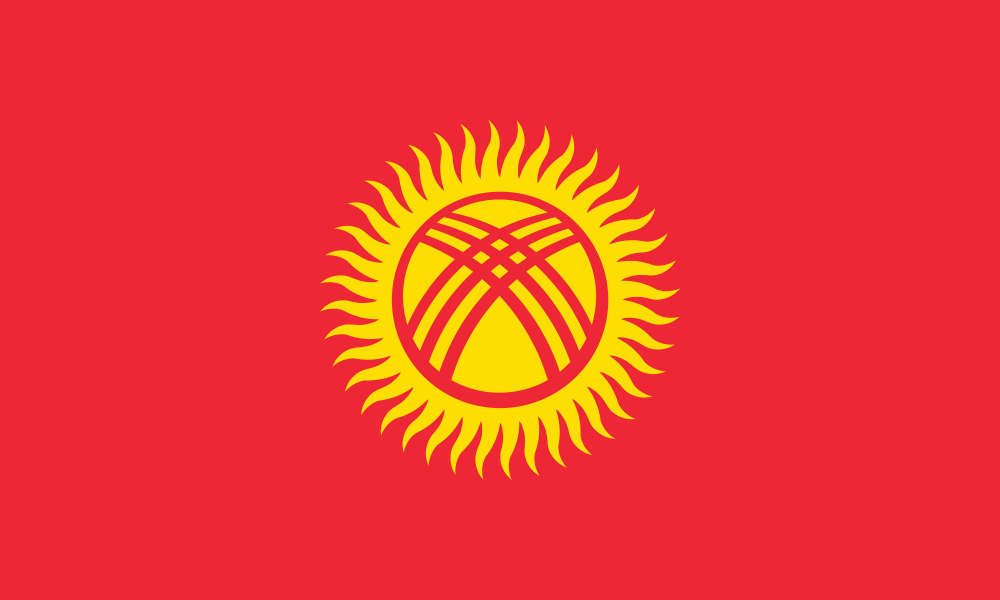
Kyrgyzstan
Overview Last updated: December, 2011
Kyrgyzstan does not possess nuclear, chemical, or biological weapons programs, and is a member of relevant nonproliferation treaties and organizations. Kyrgyzstan inherited a large uranium mining and milling complex and several military-related industrial facilities when the Soviet Union collapsed. The uranium ore mines are located in Min-Kush in central Kyrgyzstan, in Kadji-Say in eastern Kyrgyzstan, and at Tyuamuyin in southern Kyrgyzstan. [1] Kyrgyzstan is geographically situated near several countries of proliferation concern, making it a possible transshipment point for illicit trafficking in sensitive materials. [2]
Nuclear
Kyrgyzstan is a party to the Treaty on the Non-Proliferation of Nuclear Weapons (NPT) and the Comprehensive Nuclear Test Ban Treaty (CTBT), and signed an Additional Protocol agreement with the International Atomic Energy Agency (IAEA) in 2007. The foreign ministers of the five Central Asian States — Kazakhstan, Kyrgyzstan, Tajikistan, Turkmenistan, and Uzbekistan — signed the Central Asia Nuclear-Weapon-Free-Zone (CANWFZ) treaty on 8 September 2006. On 22 March 2007, Kyrgyzstan became the first country to ratify the treaty.
From the 1950s to the 1990s, the Kara-Balta Ore Mining Combine in northern Kyrgyzstan processed uranium concentrate from deposits in both Kyrgyzstan and Kazakhstan. The uranium was used in the Soviet Union's military and civilian nuclear industries. Lack of material halted production at the Kara-Balta facility in 1991, but it resumed in 1994 after the plant reached an agreement with Kazakhstan to process uranium from its Stepnoye and Tsentral mines.[3] In 2000, Kyrgyzstan entered into a joint agreement with Kazakhstan and Russia to process uranium from Kazakhstan's Zarechnoye deposit to supply Russia's nuclear industry.[4] Import of Kazakhstan's uranium ended in 2004, but a new agreement was reached after the Russian investment group Renova purchased the Kara-Balta plant in March 2007.[5] Since then, the plant has increased its production and continues to ship low-enriched uranium to Kazakhstan and Russia.[6] Numerous other mining and milling facilities once operating throughout Kyrgyzstan are now closed, though foreign companies are actively exploring for uranium and developing new mines.[7] In October 2007, after the sale of the Kara-Balta Plant, the Eurasian Development Bank (EDB) invested $150 million to modernize the mill to produce yellowcake and remove 50 years worth of uranium tailings. [8]
Kyrgyzstan faces challenges associated with uranium tailings, as large amounts of radioactive waste have "accumulated in 36 uranium tailing sites" which are dangerously close to large population centers. [9] Radioactive waste stored in Kyrgyzstan poses a significant health threat. Most of the sites are associated with the Mayli-Suu uranium processing facility, which processed over 10,000 metric tons of uranium ore for the Soviet nuclear weapons arsenal from 1946 to 1968.[10] Many storage facilities are located in areas prone to landslides, flooding, and high water levels, and are situated near densely populated areas.[11] The European Union, Russia, and the United States have provided assistance to Kyrgyzstan in developing solutions to these problems. Additionally, not all radiological materials were reported to local governments during the Soviet era, leaving these materials unaccounted for. [12] Kyrgyzstan secured 1,000 radiological materials in 2005, with approximately 500 items remaining unsecured, and an unknown number missing. [13]
Like other states in the region, Kyrgyzstan has struggled to combat illicit trafficking of nuclear-related materials. Although Kyrgyzstan began creating a legal framework for export controls as early as 1992, its virtually unsecured borders enabled trafficking along routes used to smuggle drugs.[14] In connection with the 2000 trilateral agreement on the Kara-Balta Plant, the Russian Ministry of Atomic Energy agreed to rebuild part of Kyrgyzstan's border control system by supplying equipment for at least 350km of the state's borders.[15] The United States has also provided Kyrgyzstan with millions of dollars worth of equipment and training to improve export and border control systems.[16] Kyrgyzstan signed the Minsk Accord on CIS (Commonwealth of Independent States) Export Control Coordination in 1992, but, as with other CIS initiatives, results have been limited.[17]
Biological
Kyrgyzstan is a party to the Biological and Toxin Weapons Convention (BTWC), and does not possess biological weapons.
Chemical
Kyrgyzstan is a party to the Chemical Weapons Convention (CWC), and does not possess chemical weapons. Missile Kyrgyzstan does not possess ballistic missiles capable of carrying WMD payloads.
Missile
Krygzstan does not possess ballistic missiles capable of carrying WMD payloads.
Sources:
[1] Global Security, "Kirgiz Mining Combine," April 2005, www.globalsecurity.org.
[2] Cassady B. Craft, Suzette R. Grillot, and Liam Anderson, "The Dangerous Ground: Nonproliferation Export-Control Development in the Southern Tier of the Former Soviet Union," Problems of Post-Communism, 47, no. 6, November/December 2000, pp. 39-51.
[3] Minerals Yearbook, Area Reports: International 2008 (Washington, DC: United States Government Printing Office, 2010).
[4] Minerals Yearbook, Area Reports: International 2008 (Washington, DC: United States Government Printing Office, 2010).
[5] "Kyrgyzstan again fails to sell Kara-Balta uranium plant," The Times of Central Asia, 13 October 2006; "Uranium in Central Asia," World Nuclear Association, May 2011, www.world-nuclear.org.
[6] "Uranium in Central Asia," World Nuclear Association, February 2011, www.world-nuclear.org; Jim Nichol, "Central Asia's Security: Issues and Implications for U.S. Interests," Congressional Research Service, 11 March 2010, www.fas.org.
[7] "Uranium in Central Asia," World Nuclear Association, May 2011, www.world-nuclear.org.
[8] "Partners agree to develop Kara Balta mill," World Nuclear News, 20 October 2008, www.world-nuclear-news.org; "Uranium in Central Asia," World Nuclear Association, February 2011, www.world-nuclear.org.
[9] Margarita Sevcik, "Uranium Tailings in Kyrgyzstan: Catalyst for Cooperation and Confidence Building?" The Nonproliferation Review, 10, no. 1, Spring 2003.
[10] David Trilling, "Kyrgyzstan: Radioactive Legacy Vexes Bishkek," EurasiaNet.org, 26 May 2009, www.eurasianet.org.
[11] United Nations, "Uranium Tailings in Central Asia," 2009, www.un.org.
[12] Togzhan Kassenova, "Central Asia: Regional Security and WMD Proliferation Threats," Disarmament Forum Central Asia at the Crossroads, no. 4, 2007, pp. 13-24, www.unidir.org.
[13] Rob Broomby, "Kyrgyz hunt for radioactive matter," British Broadcasting Corporation, 7 October 2005, www.bbc.com.
[14] Liam Anderson, "Export Controls in Central Asia," Center for International Trade and Security, www.uga.edu/cits.
[15] Lyudmila Romanova, Nezavisimaya gazeta, 23 June 2000, p. 5; Brian Killen, "Part of Ancient Silk Road Is Now Opium Road," www.washingtonpost.com, 3 October 1996.
[16] Bureau of European and Eurasian Affairs, "Country Assessments and Performance Measures — Kyrgyz Republic," U.S. Department of State, January 2005, www.state.gov.
[17] Sergei Ryabikin, "Representatives of CIS States Discuss Export Control Over Products Used for the Creation of Mass Destruction Weapons," RIA Novosti Hotline, 29 October 1997.
This material is produced independently for NTI by the James Martin Center for Nonproliferation Studies at the Monterey Institute of International Studies and does not necessarily reflect the opinions of and has not been independently verified by NTI or its directors, officers, employees, or agents. Copyright © 2011 by MIIS.
Get the Facts on Kyrgyzstan
- Member of the Central Asian Nuclear-Weapon-Free Zone
- Holds large amounts of radioactive waste from uranium mining and milling
- State party to the BTWC and CWC
Kyrgyzstan News on GSN
-
Canada to Aid Biosecurity in Kyrgyzstan
Aug. 18, 2009
-
Central Asian Nations Seek to Reduce "Dirty Bomb" Threat
June 30, 2009
-
U.S., Kyrgyzstan Sign Nuclear Detector Agreement
Aug. 15, 2008
-
Kyrgyzstan Intercepts Radioactive Material
Jan. 11, 2008
-
Kyrgyzstan Intercepts Radioactive Material
Jan. 11, 2008

