
Jump to search Jump to main navigation Jump to main content Jump to footer navigation

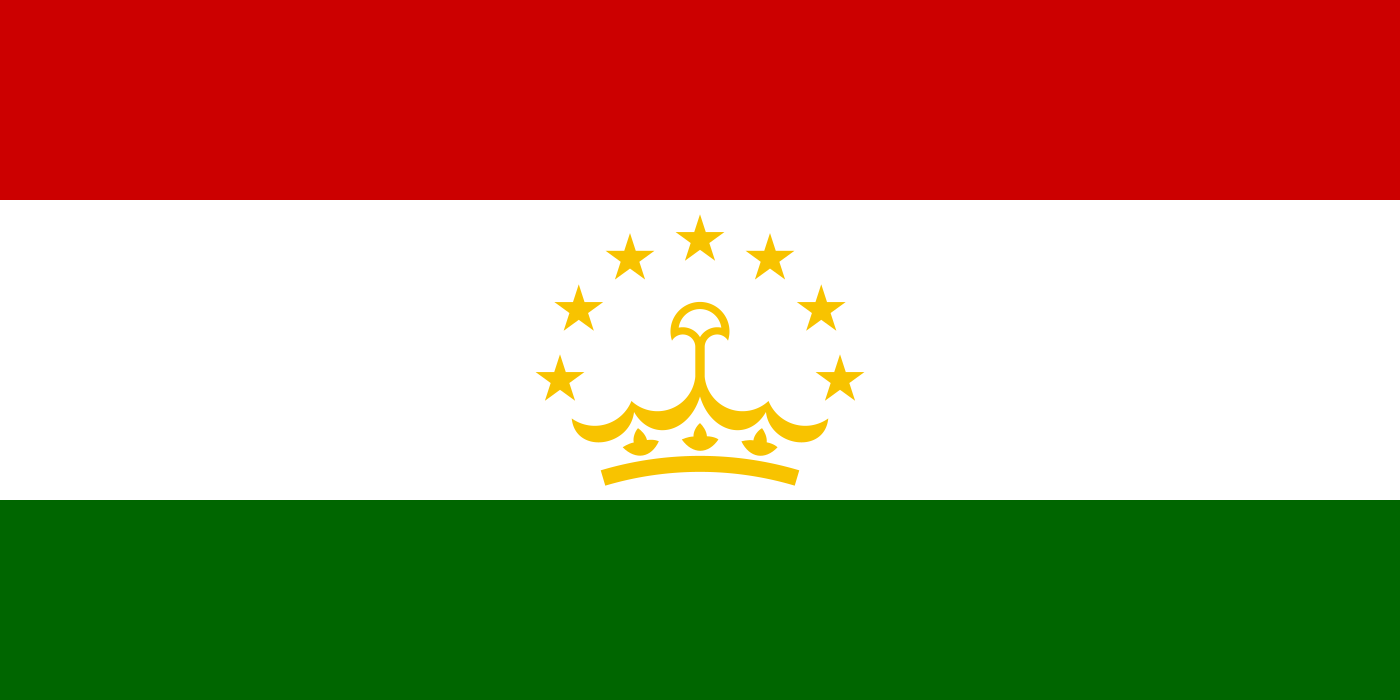
Tajikistan flagTajikistan

Overview Last updated: February, 2013

Tajikistan emerged from a devastating civil war (1992-1997) as one of the poorest countries in Central Asia. The country's geographic location, porous borders, and robust drug trade raise concerns about the potential for its territory to be used for illegal transit of materials that could contribute to weapons of mass destruction programs. [1] However, Tajikistan does not currently produce or possess nuclear, chemical, or biological weapons, and is a party to relevant nonproliferation treaties and organizations.

Nuclear

Tajikistan never hosted Soviet nuclear weapons on its territory, and its leaders have repeatedly expressed a commitment to disarmament and the prevention of WMD proliferation. [2] Tajikistan has been an IAEA member since 2001, and its Additional Protocol entered into force in 2004. Dushanbe acceded to the Treaty on the Non-Proliferation of Nuclear Weapons (NPT) in 1994 as a non-nuclear weapon state, has been a party to the Comprehensive Nuclear Test Ban Treaty (CTBT) since 1998, and has signed the Convention for the Suppression of Acts of Nuclear Terrorism. On 8 September 2006, Tajikistan joined four other Central Asian States— Kazakhstan, Kyrgyzstan, Turkmenistan, and Uzbekistan — in signing a treaty creating a Central Asia Nuclear-Weapon-Free-Zone (CANWFZ).

During the Soviet era, uranium ore mined in Tajikistan, Uzbekistan, and Kazakhstan was milled into yellowcake at the Vostochnyy Rare Metal Industrial Association (Vostokredmet), previously known as the Leninabad Mining and Chemical Combine, in Chkalovsk. [3] [4] The combine incorporated seven mines and several plants, most notably Combine No. 6 (Uranium Plant V), and processed up to 1,000,000 metric tons (t) of uranium ore per year to produce yellowcake for the Soviet nuclear power and defense industries. [5] Reportedly, Chkalovsk once had the capability to convert uranium concentrate into uranium hexafluoride, and housed a secret uranium enrichment plant built in 1940. [6] The state enterprise Vostokredmet has refocused production on gold, silver, ferromolybdenum, and the manufacturing of various goods. [7]

Tajikistan stopped mining uranium in 1992, and by law the size of its uranium reserves is considered a state secret. [8] Though the northern region containing Chkalovsk may be depleted of uranium, Tajik officials claim that the Pamir region in the south and east may contain huge uranium reserves. [9] In 2008, the Tajik government amended legislation that had prohibited foreign companies from participating in the state's uranium industry, and Chinese, Iranian, and other foreign companies are discussing potential projects with the Tajikistani government. [10]

The Argus nuclear research reactor, completed in 1991 in Dushanbe, was designed to run on 21% enriched uranium, but was never loaded with fuel. Although government officials initially expressed interest in obtaining fuel and operating the reactor, in 2007 Tajikistan asked the IAEA to dismantle the reactor and replace it with a particle accelerator. [11] While Tajikistan has no operational nuclear reactors, there are strong radiation sources on Tajik territory as a result of Soviet-era industrial applications, along with an estimated 55 million tons of radioactive waste, mostly process residue tailings from Vostokredmet. Dushanbe has considered processing the tailings to remove the remaining uranium and other minerals. [12] [13]  Currently, the IAEA is helping Dushanbe to manage the waste and seek donor funding. In June 2012 the Tajik Parliament requested assistance from its neighbors and international organizations above and beyond the funding already received from the Eurasian Economic Community (EEC). [14]

The United States, Russia, and others have assisted Tajikistan in strengthening its border security. Under the Export Control and Border Security (EXBS) program, the Global Threat Reduction Initiative (GTRI), and other programs, the United States has provided funding, training, and equipment to improve border control and secure radioactive sources. [15] In 1992, Tajikistan signed the Minsk Accord on CIS Export Control Coordination, in which the state parties agreed to create national export control systems, coordinate their efforts to control exports of materials used in the production of weapons of mass destruction, and create uniform control lists based on existing international export control regimes. [16] As has been the case with many multilateral agreements among CIS countries, however, very little has been done to implement this early attempt to coordinate CIS export control policy. [17] Russia controlled the Tajik-Afghan border from 1993 to 2005. [18]

Biological

There is no evidence to suggest that Tajikistan produces or possesses biological weapons. Tajikistan is a party to the Biological and Toxin Weapons Convention (BTWC). During the Soviet era, Tajikistan worked under the USSR Ministry of Health to administer public health-related services and institutions, including the Anti-Plague (AP) System. Tajikistan's one Regional AP Station opened in 1956 in Dushanbe, and reported directly to the AP Institute in Almaty, Kazakhstan. [19] Despite the connection between some AP facilities and the Soviet biological weapons program, there is no evidence that Tajikistan's AP station worked on any aspects of the Soviet biological weapons program.

During the Tajik civil war (1992-1997), researchers remaining at the Dushanbe AP station feared what could happen if the dangerous pathogens they worked with should be misused by the warring factions, and preventatively destroyed the station's culture collection. [20] Following the loss of its culture collection, the Dushanbe AP Station worked exclusively on cholera. [21]

With the Soviet Union's collapse, funding from Moscow was discontinued, as were collaborations with the AP network and other scientific institutes around the former Soviet Union. Most scientists and trained personnel left Tajikistan for Russia and other republics, leaving both a funding and an expertise shortage. Tajikistan joined the International Science and Technology Center (ISTC) in 2003. The ISTC funds projects at the AP station and other biological institutes in Tajikistan to keep scientists well-employed, and to improve biosafety and biosecurity while furthering science. [22]

Chemical

There is no evidence to suggest that Tajikistan produces or possesses chemical weapons. Tajik officials have stated that although Tajikistan has the capability to produce chemical precursors and toxic substances for industrial purposes, Dushanbe has not produced chemical weapons and will not do so in the future. Tajikistan is a party to the Chemical Weapons Convention (CWC).

Missile

Tajikistan does not possess ballistic missiles, and lacks the industrial capability to produce them. However, a Soviet-era plant in the city of Taboshar once manufactured solid-propellant rocket motors for Soviet strategic missiles. [23]

Sources:
[1] Togzhan Kassenova, "Central Asia: Regional Security and WMD Proliferation Threats," www.unidir.org.
[2] UN, "Central Asian nations highlight need for disarmament during UN debate," UN News Centre, September 2009, www.un.org.
[3] International Institute for Applied Systems Analysis, "International Science and Technology Center Project #245 Radleg," 1996, Kurchatov Institute, www.kiae.ru.
[4] O. Tikunov, "Uranovyye rudniki v Tadjikistane nakhodyatsya na grani zakrytiya," Russkoye Byuro Novostey, 1 February 1999.
[5] International Institute for Applied Systems Analysis, "International Science and Technology Center Project #245 Radleg," 1996, Kurchatov Institute, www.kiae.ru; Ostankino Television First Channel Network, 9 December 1993, in "Uranium Plant Changes to Gold Refining Production," FBIS Document JPRS-TND-93-001, 6 January 1994; O. Tikunov, "Uranovyye rudniki v Tadjikistane nakhodyatsya na grani zakrytiya," Russkoye Byuro Novostey, 1 February 1999.
[6] JPRS-TND-92-002, Joint Publications Research Service, 31 January 1992, pp. 50-51; JPRS-TND-92-003, Joint Publications Research Service, 14 February 1992, pp. 32-33.
[7] Leninabadskaya Pravda, 11 March 2006, in "Tajik uranium enterprise struggles to survive," BBC Worldwide Monitoring, 20 March 2006.
[8] Togzhan Kassenova, "Uranium Production and Nuclear Energy in Central Asia: Assessment of Security Challenges and Risks," China and Eurasia Forum Quarterly, Vol. 8.2, 2010, p. 227.
[9] Viktoriya Panfilova, Nezavisimaya Gazeta, 11 January 2011, in "Russia: Iran seeks uranium for nuclear programme in Latin America, Central Asia," BBC Worldwide Monitoring, 16 January 2011.
[10] Togzhan Kassenova, "Uranium Production and Nuclear Energy in Central Asia: Assessment of Security Challenges and Risks," China and Eurasia Forum Quarterly, Vol. 8.2, 2010, p. 228; "Tajikistan, China sign several cooperation accords," BBC Monitoring Central Asia Unit, 4 June 2009 Thursday, www.lexisnexis.com;"Iran to allocate 1.5m dollars to set up geological data centres in Tajikistan," BBC Monitoring Central Asia Unit Supplied by BBC Worldwide Monitoring, 20 January 2010, www.lexisnexis.com.
[11] "Tadzhikistan za nedeliu," IA Volgainform, 16 August, 2007; Anna Malikova, "IAEA approves 5 projects in Tajikistan," CentralAsiaOnline.com, 3 April 2009.
[12] Khairullo Mirsaidov, "Tadzhikistan vozobnovliaet pererabotku urana," Deutsche Welle, 9 June 2009, www.de-wolrd.de.
[13] Farangis Najibullah, "Tajikistan's Former Soviet Nuclear Sites Pose Threat To Nearby Villages," Radio Free Europe, 8 April 2009, www.rferl.org; IAEA Staff Report, "Central Asian Countries Face Radiological Legacy," International Atomic Energy Agency, 28 June 2007, www.iaea.org.
[14] IAEA Staff Report, "Central Asian Countries Face Radiological Legacy," International Atomic Energy Agency, 28 June 2007, www.iaea.org.
[15] "U.S. Department of Energy Delegation Furthers Collaboration with the Government of Tajikistan," U.S. Embassy in Tajikistan Press Release, 19 November 2004, http://dushanbe.usembassy.gov; "USA Grants 500,000 Dollars Worth of Aid to Tajik Border, Customs Committees," Interfax, 18 February 2003, in BBC Monitoring International Reports, 18 February 2003
[16] Minsk Accord on CIS Export Control Coordination, Russian-language version.
[17] Sergei Ryabikin, "Representatives of CIS States Discuss Export Control Over Products Used for the Creation of Mass Destruction Weapons," RIA Novosti Hotline, 29 October 1997.
[18] China View, "Russia transfers Afghan-Tajik border control to Tajikistan" 1 September 2005, http://news.xinhuanet.com.
[19] Alevtina Izvekova, "Issue Brief: International Assistance for Anti-Plague Facilities in the Former Soviet Union to Prevent Proliferation of Biological Weapons," Nuclear Threat Initiative, June 2005, www.nti.org.
[20] Alevtina Izvekova, "Issue Brief: International Assistance for Anti-Plague Facilities in the Former Soviet Union to Prevent Proliferation of Biological Weapons," Nuclear Threat Initiative, June 2005, www.nti.org.
[21] James Martin Center for Nonproliferation Studies Staff, Interview with Tajik AP scientist, 6 May 2003.
[22] International Science and Technology Center, www.istc.ru; Alevtina Izvekova, "Issue Brief: International Assistance for Anti-Plague Facilities in the Former Soviet Union to Prevent Proliferation of Biological Weapons," Nuclear Threat Initiative, June 2005, www.nti.org.
[23] Richard F. Kaufman and John P. Hardt (eds.), The Former Soviet Union In Transition, Joint Economic Committee Congress of the United States, 1993, p. 788.

CNS logo

This material is produced independently for NTI by the James Martin Center for Nonproliferation Studies at the Monterey Institute of International Studies and does not necessarily reflect the opinions of and has not been independently verified by NTI or its directors, officers, employees, or agents. Copyright © 2011 by MIIS.

Get the Facts on Tajikistan

  • Has 55 million tons of uranium tailings and other radioactive waste
  • Joined the CWC in 1995 and the BTWC in 2005
  • Has received funding, training and equipment from the United States to combat nuclear trafficking