
Argentina
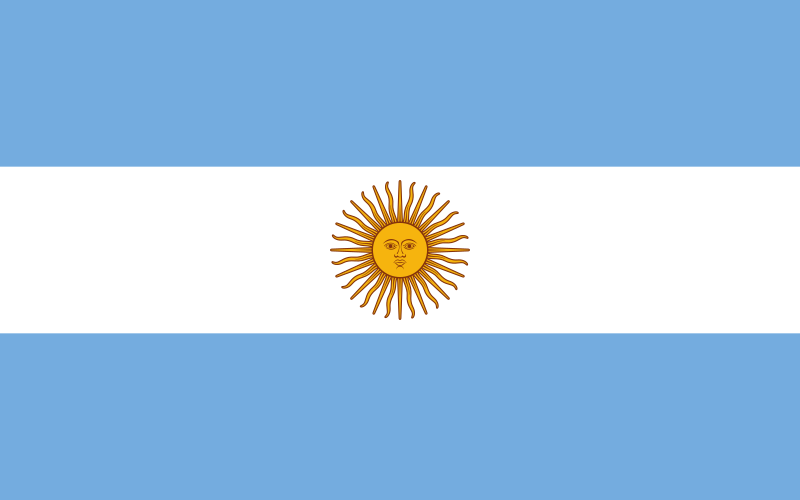
Country Spotlight
From the 1960s to the early 1990s, Argentina’s nuclear program and ballistic missile activities led to concerns that the country was seeking to develop nuclear weapons or assist other countries’ nuclear and missile programs. It has since eschewed nuclear, biological, and chemical weapons as well as missiles, but retains an ambitious nuclear energy program.
See Argentina's performance in:
Region South America, Central America, and the Caribbean
1st South American country to use nuclear energy
5% Of electricity produced by nuclear energy
Participant in U.S.-led Megaports Initiative, which prevents nuclear trafficking through seaports
Nuclear
- Joined NPT in 1995 and the Treaty of Tlatelolco in 1994, which established a nuclear weapon-free zone in Latin America
- Has exported research reactors to Algeria, Australia, Egypt, the Netherlands, and Peru
- Established a bilateral inspection agency with Brazil to verify both countries’ pledges to only use nuclear energy for peaceful purposes
- Argentina joined the “International Partnership for Nuclear Disarmament Verification” in 2015, reaffirming its commitment to nuclear nonproliferation
- Has 3 nuclear power plants in operation: Atucha I, Atucha II, and Embalse, plans to construct small modular nuclear reactors and also to restart uranium mining and enrichment to complete the nuclear fuel cycle
Biological
- Has never possessed or attempted to acquire biological weapons
- Signed the Mendoza Accord with Chile and Brazil in 1991, in which it commits not to use, produce, develop, acquire, stockpile, or transfer biological or chemical weapons
Missile
- Used French-supplied Exocet anti-ship cruise missiles against British naval forces during the 1982 Falklands War
- Developed ballistic missiles and exported missile technology during the 1980s, but dismantled its medium-range ballistic missile program, the Cóndor II, in 1992
- Member of the Missile Technology Control Regime (MTCR) and Hague Code of Conduct against Ballistic Missile Proliferation (HCOC)
Chemical
- Has never possessed or attempted to acquire chemical weapons
- Member of the Australia Group (AG) since 1992
- Signed the Mendoza Accord with Chile and Brazil in 1991, in which it commits not to use, produce, develop, acquire, stockpile, or transfer biological or chemical weapons