
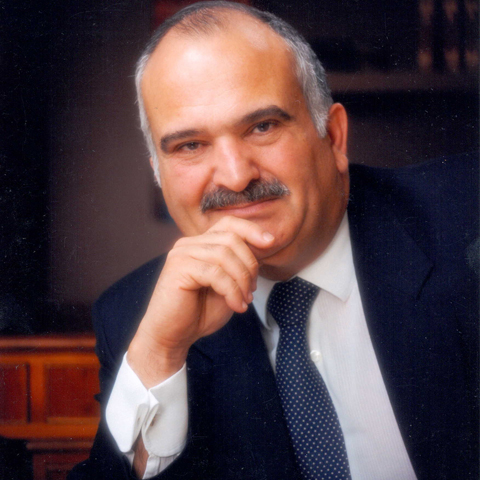
HRH Prince El Hassan bin Talal of Jordan
Emeritus Board Member
The conflagration that has swept with increasing intensity through the Middle East during the past three years has underlined the urgent need for the development of authentic regional institutions, in partnership with the concerned international authorities, to promote human security as a durable foundation for prosperity. Such an approach ultimately seeks to move beyond the current erroneous reliance on the military-security complex as the single most important cornerstone of state stability.
During the past 50 years, it is evident that the dignity of individual citizens has been sacrificed for the short-term and essentially illusory aim of political quietude. However, today’s deeply entrenched discontent across the region has ultimately proven the unviability of this approach.
These concerns have long been central to Jordan’s worldview. As such, I have repeatedly called for:
This path suggests how in the long-term any subsequent durable regional peace can be created once the current and seemingly intractable conflict blighting the region has been surmounted.
A number of other regional thinkers have also sought to define the steps towards creating a more stable Middle East. In September 2013 Egyptian Foreign Minister, Nabil Fahmy outlined a three-step plan at the UN General Assembly. This included:
While numerous academic efforts have taken place in the West to examine Arab and Muslim perspectives on WMDs, no similar attempt has been made within the region itself. As such, the Middle East Scientific Institute for Security (MESIS), another organsiation with which I am associated, has sought to develop an authentic Arab and Muslim voice on WMD-related concepts, and articulate a common position. The objective of this work is to develop a common regional understanding on WMDs through an Islamic lens. The intended outcomes are to:
Likewise, the Arab Forum on Security and Nuclear Non-Proliferation has proposed the establishment of a West Asian WMD-free zone. Partner organisations include the Arab Thought Forum, of which I am chairman and the Arab Institute for Security Studies at the University of Jordan.
Ultimately, true security in the Middle East can only be built upon a representative regional voice articulating a pluralist position on both WMDs and stability, with the consensus of both state and non-state actors alike. Only then will attempts to foster stability endure, through changing mutually assured destruction into mutually assured survival.
Sign up for our newsletter to get the latest on nuclear and biological threats.

This paper outlines six practical options that non-nuclear weapon states could pursue to reduce nuclear risks amid heightened geopolitical tensions. The options were developed based on interviews with nuclear policy experts from around the world. They reflect priority areas where government investment could have the most near- to medium-term impact, as well as the tools and channels through which these efforts could be advanced.
The Nuclear Threat Initiative (NTI), Euro-Atlantic Security Leadership Group (EASLG), Asia-Pacific Leadership Network (APLN), and European Leadership Network (ELN) have worked since March 2020 to highlight the benefits of independent, internal “fail-safe” reviews in nuclear-armed states.

Despite the high stakes, the economic and financial considerations of nuclear weapons use remain underexplored. This paper examines several decades of research on economic and financial effects of nuclear weapons use, and explores the key gaps in our understanding of effects in today’s interconnected world.
Sign up for regular updates on innovative, real-world solutions to existential threats.