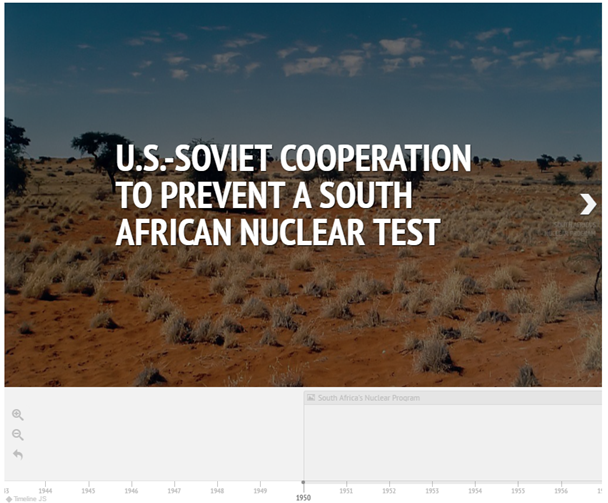
A new interactive historical
timeline about South Africa’s nuclear weapons program published yesterday shows that it’s possible for adversaries to find common ground when it comes to
tough global security challenges such as nuclear nonproliferation. The timeline,
which is featured in an article by Sarah
Bidgood and William Potter from the Center for Nonproliferation Studies (CNS),
illustrates how the United States and the Soviet Union worked together during
the peak of the Cold War to prevent a South African nuclear test in the
Kalahari Desert. The examination of this
South African case study is part of a larger project being undertaken by these
authors and a team at CNS to identify drivers of past U.S.-Soviet/Russian
cooperation and obstacles that needed to be overcome for cooperation. Learning
the lessons of history can help contemporary decision makers identify areas for
cooperation with counterparts on nonproliferation and other international
security issues, even when relationships may be strained.
View the timeline and article here.