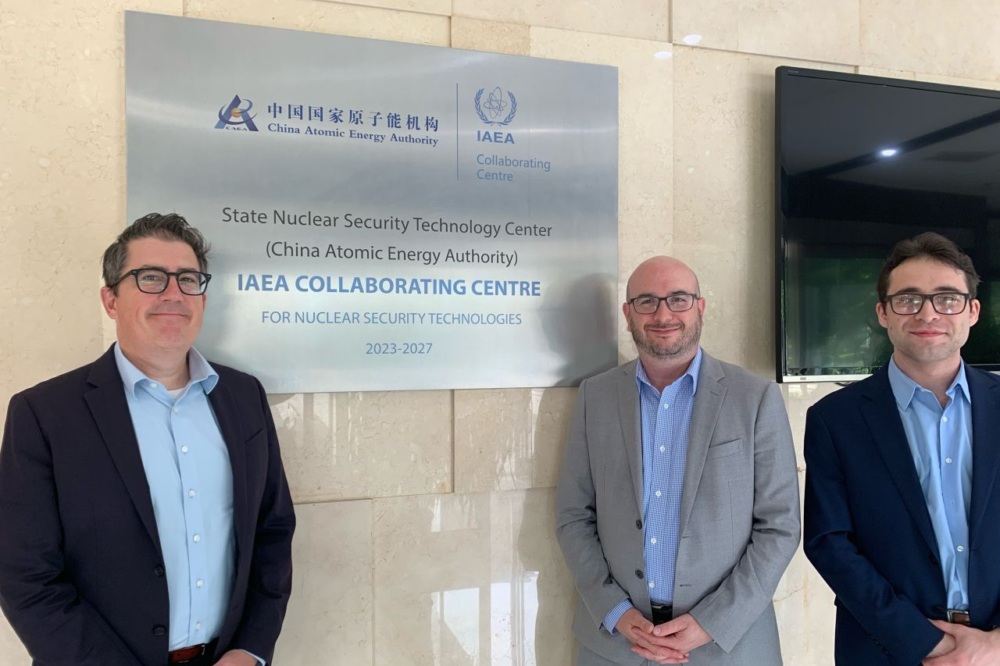
Ten years ago, China and the United States jointly opened a Center of Excellence on Nuclear Security outside Beijing. Today, strategic competition between the two countries has derailed official engagement on nuclear security, and NTI is working to keep the expert-level conversation going. From July 28-29, 2026, NTI, the China Arms Control and Disarmament Association (CACDA), and the State Nuclear Security Technology Center (SNSTC) hosted the China-U.S. Track II Dialogue on Nuclear Security at the SNSTC-operated Center of Excellence.
The dialogue, which has met multiple times since 2018, is a rare opportunity for experts from both countries to share perspectives on emerging nuclear security risks. Participants from a broad network of research centers and technical institutes exchange insights, build relationships, and develop a shared vision for strengthened nuclear security cooperation between Beijing and Washington.
Titled “Adapting Nuclear Security Frameworks to an Era of Rapid Technological Change,” the July dialogue engaged experts on three broad themes:
- AI applications in nuclear security, including the incorporation of AI into nuclear security culture and use cases for AI in data management and intrusion detection
- Security of emerging nuclear technologies, including regulatory approaches for advanced reactors and SMRs given the latter’s modular deployment model
- International governance, including strengthening norms against state attacks on peaceful nuclear facilities and using the upcoming review of the Amended Convention on the Physical Protection of Nuclear Material (CPPNM) to express both countries’ commitment to the international nuclear security system.
CACDA Secretary General Dai Huaicheng, SNSTC Deputy Director Wang Yuqing, and NTI Vice President of Nuclear Materials Security Scott Roecker each delivered opening remarks. Roecker set the scene by addressing the current nuclear security landscape, highlighting the most important trends of the last decade and the greatest opportunities for China-U.S. cooperation, including on capacity-building efforts ahead of the 2027 Amended CPPNM review and on small modular reactor and advanced reactor regulations. Secretary General Dai and Deputy Director Wang similarly emphasized the need for continued China-U.S. discussions on salient nuclear security topics.
During the dialogue itself, members of each delegation presented their respective analyses, followed by productive discussion sessions where participants identified common nuclear security goals. The dialogue concluded with a cross-cutting exchange that highlighted opportunities for cooperation between the two governments and identified next steps for advancing the shared priorities that emerged from the discussion.