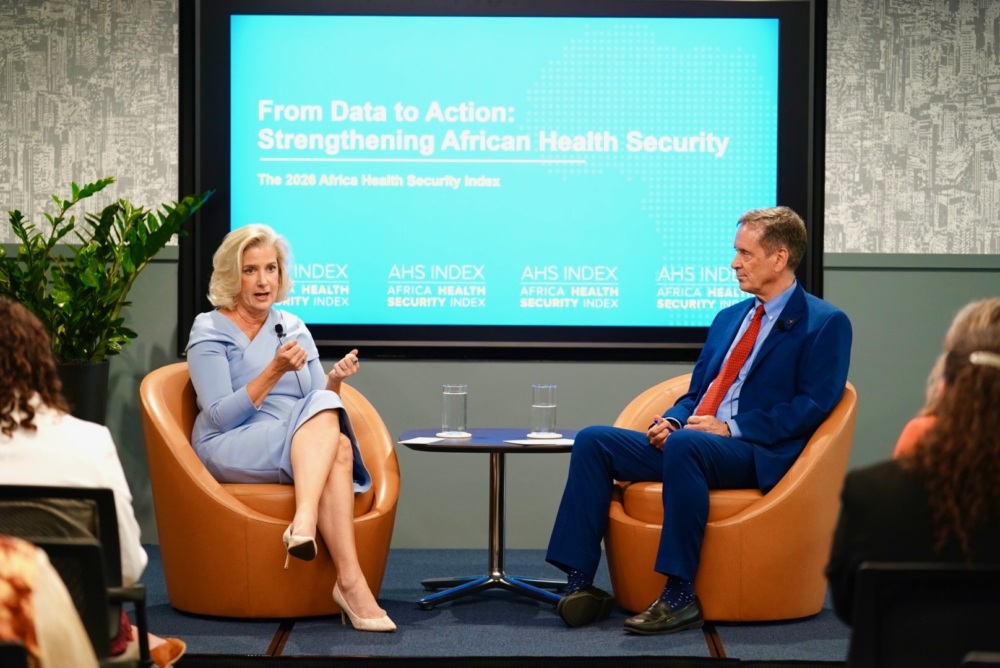
Amid a changing funding landscape, leaders gathered at NTI on October 7 to discuss how data from the 2026 Africa Health Security Index can guide critical decisions to sustain preparedness across Africa.
African countries have made significant gains since 2021, with the continent’s average Index score rising by nearly 30 percent. However, the Index also shows critical gaps remain in biosecurity and biosafety, emergency response, workforce development, financing, and health system resilience.
Ambassadors and officials from African embassies, U.S. government representatives, and health security and philanthropic leaders joined NTI for a fireside conversation between Secretary Christine E. Wormuth, NTI president and CEO, and Ambassador Mark Green, president and CEO of the ONE Campaign. Drawing on their experience in national security, development, and diplomacy, the two discussed the challenge of sustaining preparedness across the continent and reiterated the role of data to support focused investments to drive change.
“One of the really heartening things is the fact that we saw a nine-point average increase in the overall Index score. There are, of course, significant gaps in several specific areas,” Wormuth said.
Scores for biosecurity and biosafety remain low across the continent. Many countries lack the systems, policies, and technical capacities needed to prevent accidental or deliberate pathogen releases. “The costs associated with a situation where some sort of a dangerous pathogen was insufficiently secured are going to be astronomically more substantial than the investment in the biosecurity area,” Wormuth noted.
She cautioned that political will is fading. “I think one of the challenges that many African countries are experiencing that, frankly, we’re experiencing here in the United States is that the urgency that our governments and public health systems experienced during the pandemic is now in the rearview mirror,” she added.
A recurring message from the discussion was that preparedness is more than building capacity. It requires ensuring that countries and partners can activate, coordinate, and sustain capacities when they are needed most. The ongoing Ebola outbreak in the Democratic Republic of the Congo underscores this challenge, demonstrating how a deteriorating risk environment can negatively affect readiness and response despite measurable capacity gains.
Wormuth and Green pointed to the Index as a tool to help governments, donors, and implementing partners decide where to invest. By identifying each country’s strengths and vulnerabilities, it provides evidence for prioritizing and targeting resources.
Declining official development assistance poses a growing challenge to sustain health security capacities. At the same time, the changing funding landscape may create opportunities to rethink traditional donor-recipient relationships and support greater country ownership, investment, and health sovereignty.
“The most important thing that the U.S. and donor partners can do, is to look for ways to invest in domestic resource mobilization and health care financing,” said Green. “I think as friends and partners of Africa […] we should be spotting and incentivizing investments through co-investment. I think the Index is an extraordinarily useful tool for helping us to spot opportunities.”
Green also emphasized the connection between health security and economic opportunity, highlighting the potential for American businesses to invest in developing economies. “Having high marks in the Index is actually a way to attract investment and creates stability in the countries in which you’re investing,” he said.
Green concluded with a reminder that in an interconnected world, one country’s health security affects every country. “We need to be investing in this because it’s not just African health, it’s American health. It’s a matter of humanity going together,” he added.
Africa Health Security Index recommendations echo Green’s call, urging governments and funders to publicly commit to financing preparedness through domestic resources, global pledges, and co-investment.
Index data can help governments, donors, and partners make informed decisions about action. Strengthening readiness and building a more resilient future across the continent relies on transforming those insights into ongoing action.