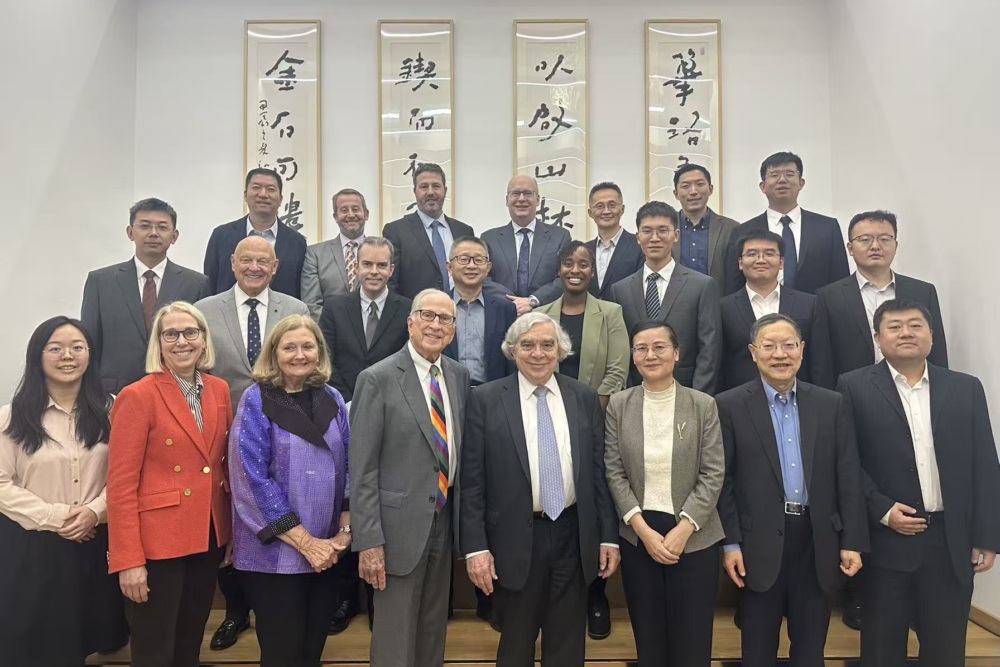
At a time of rising global tensions and rapid technological change, NTI continues to deepen its international partnerships and promote productive dialogue on nuclear risk-reduction efforts. From October 11–14, 2025, NTI CEO and Co-Chair Ernest J. Moniz and NTI Co-Founder and Co-Chair Sam Nunn led a delegation of former high-level U.S. government officials and NTI staff to China for a series of meetings with Chinese government officials and experts. The visit focused on advancing nuclear fail-safe reviews—a risk reduction practice aimed at reducing the likelihood of accidental, mistaken, or unauthorized use of a nuclear weapon.
The delegation, which included Madelyn Creedon, former Principal Deputy Administrator of the National Nuclear Security Administration; Admiral James Ellis (Ret.), former Commander of the U.S. Strategic Command; and Joan Rohlfing, former NTI President and Chief Operating Officer, met with representatives from the Chinese Ministry of Foreign Affairs and the China Institute of Atomic Energy, and attended a two-day workshop co-organized with the Asia-Pacific Leadership Network (APLN) and hosted by the Grandview Institution.
The workshop was the second fail-safe dialogue that NTI, APLN, and Grandview have convened in China as part of NTI’s multi-year effort to champion such reviews as a practical step that all nuclear-armed state can take in a time of profound nuclear risks. Participants discussed key developments since the first workshop last year, including the implications of emerging technologies for fail-safe reviews and the results of similar fail-safe workshops NTI participated in with India, Pakistan, France, and the United Kingdom. Participants also shared reflections on the United States’ two successful fail-safe reviews and discussed perspectives on fail-safe in China and pathways to facilitate global fail-safe reviews.
NTI staff also traveled to Shanghai to meet with the Shanghai Institutes of International Studies to discuss future cooperation on a sustained and results-orientated dialogue on reducing the risk of a nuclear arms race and preventing the use of nuclear weapons.
Together, these engagements underlined to all participants great potential for future collaboration and progress on nuclear fail-safe reviews, the mutual benefit that fail-safe reviews can provide, and the urgent need for dialogue on managing the risks in the U.S.-China strategic relationship.