
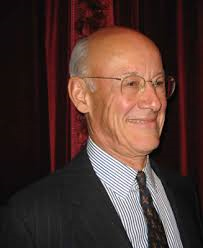
 Barrie Wigmore has supported the work of NTI and its Co-Founder, Sam Nunn, from the beginning. He is a retired partner of Goldman Sachs, a company he joined in 1970. Before retiring in 1988, he headed the corporate finance department responsible for utility, pipeline, telecommunications, and oil and gas financing. He is the author of four books and numerous academic articles on financial markets. He is a trustee emeritus of the Metropolitan Museum of Art and a former member of the Investment Committee for its $54 billion endowment. He is also former Chairman of the Trust for the Endowment of Worcester College (Oxford).
Mr. Wigmore spoke with NTI’s Vice President of Development, Hugh Sullivan, about why people like him might consider making a planned gift to NTI.
Why I Support NTI’s Mission
Q: What initially drew you to support NTI?
A: First and foremost, it’s my faith in Sam’s leadership and his belief in the importance of this work. I support NTI because I trust Sam’s judgment that these issues are critical. Strong leadership and management are essential for any organization I choose to support.
Q: What makes NTI’s role as a non-governmental organization unique in addressing existential threats?
A: Where governments can’t gain trust, NTI can build bridges and develop sophisticated controls.
Q: How do you see the threat landscape today compared to when you first became involved?
A: The nuclear threat is greater today than ever, but the solutions are more challenging to achieve. Countries today don’t trust outsiders, which makes NTI’s work both difficult and essential. The risk of catastrophe looks more proximate in Eastern Europe, Israel/Iran, and India/Pakistan. As the saying goes, ‘two out of three ain’t bad’ – but with nuclear risks, we need zero out of three.
Q: You support many established institutions. How does NTI compare to other organizations in your philanthropic portfolio?
A: Unlike the Metropolitan Museum or Oxford University with their billion-dollar endowments and long histories, NTI doesn’t have that financial stability. We’re happy to support NTI, and we think long-term financial planning is essential for it to continue its critical work. So I’d say first – if you’re considering giving, why not give annually? NTI can put 100% of your contribution toward managing urgent risks.
But I’d also say this makes planned giving all the more important – this is a well-managed organization, but it won’t exist without donor support, and its mission is absolutely necessary.
Q: Tell me about your giving philosophy? Do you support restricted causes or general operations, and how can planned giving help?
A: Our practice has been to support operations. That’s critical for organizations like NTI where much of the work depends on professional expertise. Most people want to see metrics and tangible outcomes, but nobody wants to support salaries anymore. Yet for NTI, professional expertise is the core of what they do. A planned gift of lasting funds can provide the operational support to address issues that require long-term focus.
Q: From your background in finance, how do you view the importance of addressing nuclear threats compared to other global risks?
A: Most organizations don’t account for extreme risks – what financial experts call ‘Black Swans.’ The world just doesn’t price in these catastrophic possibilities. That’s what makes NTI’s task so vital and so challenging. In the financial world, we saw in 2007-2008 what happens when we ignore extreme risks. With nuclear threats, we can’t afford to make that same mistake.
Q: What gives you confidence that NTI can continue to make a difference in reducing nuclear threats?
A: I’ve seen firsthand how an independent organization could step in where governments couldn’t and create real security solutions. NTI’s track record gives me confidence that it is essential in addressing today’s complex nuclear challenges.
Q: What would you say to someone who is considering making a planned gift to NTI?
A: I continue to support NTI in faith – faith that addressing catastrophic risks is essential for future generations, even when the work is technical and difficult to communicate. And I believe there are more people out there who would agree.
To me, fundraising is about helping people do what they want to do. It’s not talking them into something – it’s finding people who want to make a difference and showing them how to do it effectively. This could be a uniquely effective option for some people to explore.