

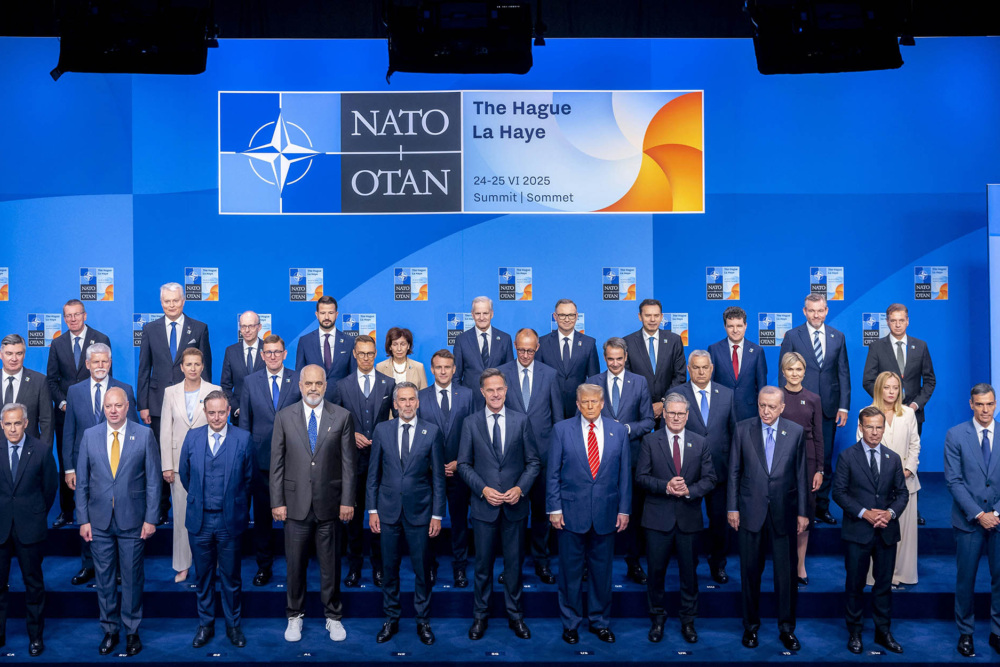
About the image
Anxiety swirled as world leaders prepared for the 76th NATO Summit in The Hague from June 24–25. Many NATO leaders were concerned for the future of the Alliance as the United States hinted that it might scale back its European military presence and reconsider its support for NATO’s Article 5 (an attack on one member is considered an attack on all).
With force modernization as a topline issue, it was clear that the changing security landscape is reshaping the members’ vision of the nuclear alliance.
The summit was largely viewed as a success by NATO leaders and NATO Secretary General Mark Rutte:
This year’s summit declaration was brief—just under 500 words compared to last year’s 5,300 words. The shift in length also came with a significant shift in substance and tone.
One of the most significant outcomes was that NATO Allies agreed to increase their annual GDP committed to defense from 2 percent to 5 percent by 2035—3.5 percent dedicated to “core requirements” and 1.5 percent for critical infrastructure and the defense industrial base. This change aligns with the U.S. administration’s push to encourage European allies to invest more in their own security.
The Russian invasion of Ukraine was on the backburner at the summit and Ukraine’s bid to join NATO was not addressed. This year’s declaration language referencing Russian aggression was less condemning than before, stating simply that Ukrainian “security contributes to ours.”Moreover, last year’s declaration called Russia the “most significant and direct threat to Allies’ security,” while this year, Russia was described as a “long-term threat” to regional stability. According to the Telegraph, the Allies agreed to subdued language surrounding the war in Ukraine to appease President Trump; they also agreed to omit any explicit mention of the conflict “in exchange for Mr. Trump’s commitment to NATO’s Article 5.”
Ukraine’s bid to join NATO remains uncertain. While NATO Secretary-General Mark Rutte stood firm that Ukraine’s road to accession is “irreversible,” members of the Trump administration and Hungarian Prime Minister Viktor Orbán have outright rejected the idea.
During talks between Presidents Trump and Zelenskyy on the margins of the summit, Trump hinted at potentially supplying Ukraine with and stressed his commitment to ending the war. Two weeks after the summit, Trump pledged to send Ukraine defensive reinforcements, indicating that, while Ukraine may not have been the headline event at this years’ summit, the United States remains committed to ensuring Ukrainian sovereignty.
The Allies released several new plans that signal their evolving priorities and a new focus on technology, innovation, and leveraging the commercial market:
The summit’s broad push toward force modernization has implications for NATO’s nuclear policy.
UK Prime Minister Starmer announced the purchase of at least 12 new F-35A fighter jets (aircraft capable of carrying both conventional and nuclear payloads) to reinforce NATO’s nuclear deterrence posture. This marks the first time since the conclusion of the Cold War that the United Kingdom will have nuclear capable aircraft to support NATO’s nuclear mission. Increasing sovereign defense capabilities will enhance the Alliance’s posture and credibility of “deterrence by denial,” and its identity as a nuclear alliance.
The move may bolster NATO’s deterrent against threats on its Eastern front, but it also raises concerns about an intensifying arms race: NATO’s emphasis on modernization increases the risk of a security dilemma—where a country’s buildup of arms to enhance its own security drives other countries to weaponize, inviting potential
NATO uses nuclear weapons as a tool for deterrence, but this is not a sustainable long-term strategy. The world is becoming more complex, deepening the risk of conflict and arms races. NATO must remain prepared without augmenting the likelihood of inadvertent escalation. The focus should remain on dialogue and risk reduction which can help NATO achieve its goal to “create the security environment for a world without nuclear weapons.”
Sign up for our newsletter to get the latest on nuclear and biological threats.

The integration of AI into nuclear systems is underway. The guardrails, safety, and security frameworks needed to understand and manage the consequences are not. A new generation of AI-informed nuclear fail-safe reviews is urgently needed in all countries with nuclear weapons.

Most of us think of cognitive biases as quirks of everyday decision-making, but a recent Texas National Security Review study shows they are deeply embedded in people’s attitudes toward nuclear weapons and war.
After four weeks of intense negotiations, it is entirely understandable to feel frustration, disappointment, and anger. What we cannot afford is for diplomats, policymakers, and publics to internalize that frustration as resignation.
Sign up for regular updates on innovative, real-world solutions to existential threats.