

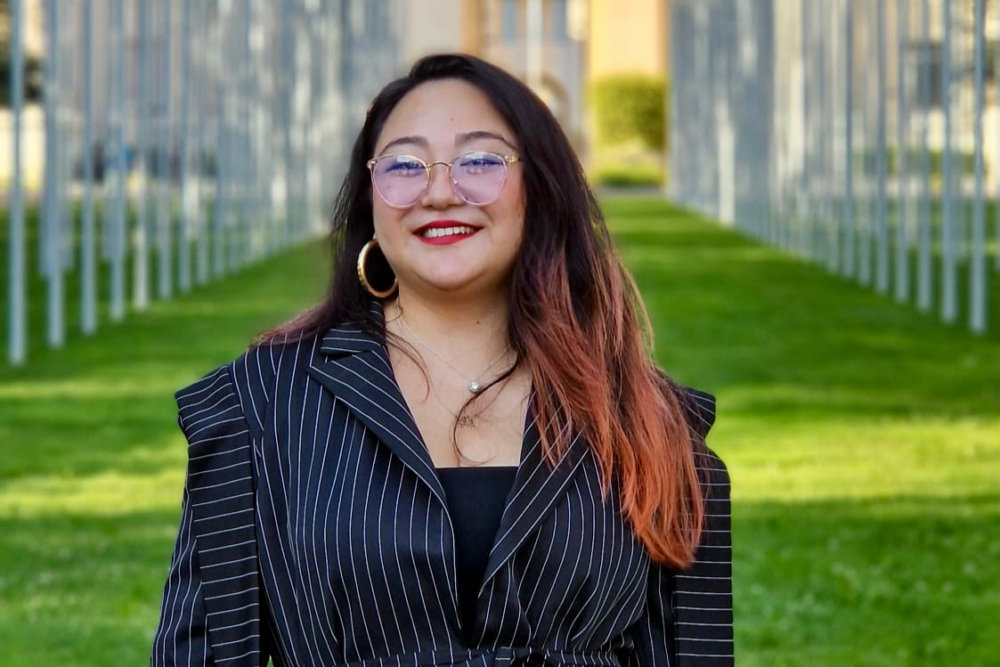
NTI’s “Young Voices” series highlights early-career professionals making their mark as part of the community of experts tackling today’s existential threats. This series reflects NTI’s commitment to uplift a range of voices and ideas, help break down stereotypes that contribute to generational divides on security and give a platform to young people to share creative ideas that address the evolving threats posed by weapons of mass destruction and disruption.
Siri Beck-Friis, NTI’s Global Nuclear Policy Program intern, had the chance to speak with Aigerim Seitenova, a human rights professional and nuclear justice advocate from Kazakhstan. She is the co-founder of the Qazaq Nuclear Frontline Coalition, an initiative that addresses the collective fight for justice for those affected by Soviet nuclear testing in her home region. Aigerim is a third-generation survivor of Soviet nuclear testing in Semipalatinsk, which profoundly shaped her activism. She is also a producer and a director of the documentary film JARA – Radioactive Patriarchy: Women of Qazaqstan, which tells the stories of six women from a nuclear-affected community in Kazakhstan. This interview has been edited for length and clarity.
Could you share a little about your current role? What are you currently working on?
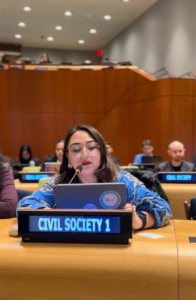
I’m a co-founder of the Qazaq Nuclear Frontline Coalition (QNFC), and we work on both national and international levels. In Kazakhstan, we engage with government institutions and Parliament to advocate for reforms to the law supporting citizens affected by Soviet nuclear testing. Internationally, we promote nuclear justice by collaborating with affected communities and contributing to efforts under Articles 6 and 7 of the Treaty on the Prohibition of Nuclear Weapons (TPNW), which focus on victim assistance and environmental remediation. Soon, I hope to launch a digital platform that will function as an online museum documenting Kazakhstan’s nuclear legacy.
 What was your inspiration for getting into the field of nuclear disarmament? Was there a particular moment or realization that motivated you?
I entered this field in 2021 while pursuing a master’s degree in international human rights law in the United Kingdom. I attended a webinar on nuclear legacies that featured an animated film about the displacement and destruction caused by the U.S. nuclear tests at Bikini Atoll in the Marshall Islands. Watching it helped me connect my academic research on human rights and civil society with the experiences of my own community. I realized how underrepresented young Kazakh activists from affected communities were in the nuclear disarmament field, especially as experts rather than victims. That was the moment I thought, “I have experience and education; I belong in this space.”
After completing my degree, I returned to Kazakhstan determined to involve more young people in nuclear justice. Around that time, Russia’s full-scale invasion of Ukraine had already sparked some youth interest in nuclear weapons. A major milestone came in 2023, when I brought together six young people to attend the Second Meeting of States Parties (2MSP) to the TPNW. It was the first time Kazakh youth were represented so strongly, and independently of the government, at a nuclear disarmament forum.
To foster youth organizing in the field, before 2MSP I founded a youth initiative for nuclear justice, Steppe Organization for Peace, and invited emerging activists to join me. But eventually, I felt the need to build something more intergenerational. While the Kazakh youth movement was gaining momentum, many older survivors—the first witnesses to nuclear testing—don’t speak English, and some are now passing away. Bringing their voices into this work felt essential. That’s what ultimately led to the creation of the QNFC.
You mentioned that the QNFC works on laws supporting survivors of nuclear testing in Kazakhstan. To what extent are nuclear testing survivors being compensated, and what limitations are there?
After Kazakhstan’s independence from Soviet rule, the country was new, with no real economy, trying to navigate the global arena. Despite this, in 1992, the government adopted a law to provide social protection for people affected by nuclear testing. It offered a one-time cash payment to anyone born between 1949 and 1990 who lived in radiation-exposed zones and developed certain health conditions. The calculation is quite technical, and unfortunately the compensation amounts have been reduced over time.
The law also offers smaller monthly payments, but only for those who are formally employed, not the unemployed or self-employed. Some additional benefits exist for pregnant women and military personnel, but many are tied to specific regions, so moving elsewhere can mean losing support. There are many obstacles. That’s why I advocate not only for better compensation schemes, but also for broader, transformative justice: improved healthcare and socioeconomic conditions in Kazakhstan.
 Tell me a little about JARA — Radioactive Patriarchy: Women of Qazaqstan. How did you get the idea of producing this documentary?
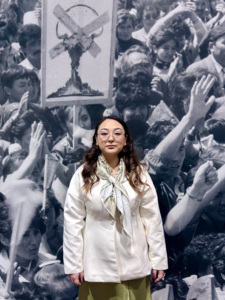
Jara means “wound” in Kazakh. For me, it was important to expose the nuclear wounds left by decades of nuclear testing, spreading across our land and all living things in Kazakhstan. The documentary focuses on Kazakh women and the idea of “radioactive patriarchy”: how nuclear weapons, as a product of patriarchy, have harmed communities worldwide. The film is predominantly in Kazakh, unlike most similar documentaries on nuclear testing, which are in Russian or English.
The film also became a way for me to reflect on my own legacy. The idea came to me as I began talking with my relatives about their experiences with nuclear testing, which I felt compelled to share in the film. At the same time, I was becoming increasingly aware of the underrepresentation of women, both globally and within my own community, and the silence around their nuclear legacy. I wanted to bring women’s stories to the forefront—not only on the biological effects of radiation, but also the social stigma and socioeconomic inequalities they face, especially in their roles as caregivers. Equally important, I wanted to highlight their agency as activists and community leaders, since civil society in Kazakhstan is largely built by women.
What do you want viewers to take away from JARA?
The process of making the film was deeply important to me. Too often, journalists and filmmakers approach affected communities without enough sensitivity. Every summer, around the International Day Against Nuclear Tests, people arrive in our region to shoot films, write articles, or pursue well-funded projects; they ask the same questions as every other year—and nothing changes for us. Many produce quite sensationalist work, using distressing images of babies affected by nuclear testing, and so on.
With my film, I wanted Kazakhs to have real agency and show that nuclear legacy is more than that. I was careful not to traumatize or re-traumatize anyone, so I interviewed only a handful of people: my niece, my great-aunt, and activists who wanted to share their stories. It felt important to create a safe atmosphere—to have a cup of tea together and create space for reflection. In that sense, the film became part of a process of healing, too. I dedicated it to my grandmother, who passed away 24 years ago, to honor her legacy.
What advice would you give to people who want to engage with these issues without burdening affected communities with undue emotional labor or responsibility?
I welcome people who come to our region to work on nuclear testing and its legacy, but projects like this take time. You need to build genuine, trusting relationships with the people you interview or film, and be honest about your objectives and what you can realistically achieve. The Nuclear Truth Project’s Protocols provide helpful guidance for both affected communities and third parties on how to work with respect and reciprocity. At the core, it’s about informed consent and not treating us as research subjects; our communities have already been used as scientific subjects during the nuclear testing era. It also means co-designing projects, programs, and events with us, and paying us for our contributions. In essence, treat us as equal partners, not just victims.
With your personal, academic, and professional engagement in such a challenging and important field, what keeps you motivated?
Being a community organizer and activist in a system that often undervalues you is tough. Despite the pain and trauma, being part of a community—including affected communities from other countries—helps a lot. It reminds me that we are not alone and that we share a common goal. One of the most powerful moments of my life happened recently at the Third Meeting of States Parties to the TPNW, during a screening of JARA. Community members, including people from Kazakhstan, came to watch, and the whole room was crying. I will never forget the support I felt from my friends and allies in that moment. Moments like that keep me motivated.
Thank you so much for sharing your story, and for all the important work you do for nuclear justice in Kazakhstan and beyond.
Sign up for our newsletter to get the latest on nuclear and biological threats.

The integration of AI into nuclear systems is underway. The guardrails, safety, and security frameworks needed to understand and manage the consequences are not. A new generation of AI-informed nuclear fail-safe reviews is urgently needed in all countries with nuclear weapons.
Most of us think of cognitive biases as quirks of everyday decision-making, but a recent Texas National Security Review study shows they are deeply embedded in people’s attitudes toward nuclear weapons and war.
After four weeks of intense negotiations, it is entirely understandable to feel frustration, disappointment, and anger. What we cannot afford is for diplomats, policymakers, and publics to internalize that frustration as resignation.
Sign up for regular updates on innovative, real-world solutions to existential threats.