
Unlike past technological disruptions to global security which were driven by governments, market forces and business dominate today’s global innovation space. Preserving global security will take bold partnerships and new and adaptive approaches. As the world rapidly changes, emerging technologies are forcing us to rethink our approaches and priorities in order to build a safer future. At NTI, our FutureSafe program explores how converging technology fields are reshaping global security, creating both innovative opportunities and new risks, and finding ways to take action. This includes working not only with thought leaders, but the doers that affect change.
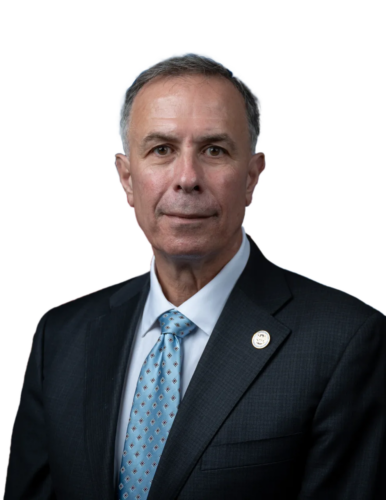
At our latest FutureSafe Innovation Forum, I hosted Dr. Kimberly Budil, the Director of Lawrence Livermore National Laboratory (LLNL), to discuss the unique missions of the laboratory and a set of wide-ranging issues from U.S. nuclear modernization and the future of national security science to biosecurity and the growing impacts of emerging technologies on our security.
When the U.S. stopped testing nuclear weapons in 1992, it shifted to using computer simulations and experiments to support the maintenance of the U.S. stockpile. This approach helps answer key questions about how the weapons work without physical testing. Budil showcased some of the developments that underpin this.
Delivering the El Capítan supercomputer at a peak performance of 2.75 exaflops – that is the ability to perform 2.75 followed by 18 zeros mathematical operations per second – allows for simulations that address nuclear security priorities in ways never before possible. “This is by far the biggest step we’ve ever taken and what that capability enables is…high-fidelity 3D full-system simulations at scale every day at quantity,” explained Budil, describing the ability to answer detailed questions related to our aging nuclear weapons stockpile and the life-extension efforts our nation pursues. Billions of dollars can rest on decisions based on simulations. For NTI, this opens the space of possibilities to ensure explosive nuclear testing remains a thing of the past.
The National Ignition Facility (NIF) continues to show that nuclear fusion reactions can be achieved in the lab, which produces more energy from fusion energy than the amount of laser energy used to start the reaction. “For a fraction of a second, a billionth of a second, we produce more power than…the entire U.S. electric grid”, Budil noted. Their progress is driving an unprecedented growth of private sector fusion energy start-ups, which is shifting nuclear expertise to the private sector. For FutureSafe, this is a notable trend showing technology access and expertise spreading away from government and into other sectors. This shift highlights the need to think more broadly about who we partner with to keep the world safe. It is one example of how innovation is moving into new spaces and why expanding our collaboration is essential.
Parts of the U.S. nuclear infrastructure are decades old and modernizing it could cost trillions of dollars. Rethinking historical approaches offers both economic and security advantages. LLNL is rethinking this but change in this space will be challenging. FutureSafe has an opportunity to build on current progress and shape new, effective modernization strategies. This includes convening experts, exploring new ideas, and testing options that can meet the demands of a rapidly changing world.
LLNL’s storied history in the life sciences —from studying radiation effects to developing the Human Genome Project and responding to Covid-19—continues today. Budil explained that “developing drugs typically takes…a decadal timescale…about 90%…fail along that path. We’ve developed a computational pipeline and a set of experimental platforms that have allowed us to dramatically shorten that timeline.” More significant are the doors that are opened in emerging technologies that “can identify unknown agents”. As FutureSafe explores tools like edge devices or digital twins and many adjacent technologies to strengthen biosecurity, these advances open exciting new possibilities.
Budil’s vision in national security science points toward a future in which the strength of our science and technology outpaces the threats we face. The conversations we host in the FutureSafe Innovation Forum are designed to spark new ideas by connecting developments across different technology fields. These conversations help us stay focused on building a safer world. We need more open, cross-sector dialogue and tangible actions. In November, we will release a report titled Nuclear Security Implications of AI and Emerging Technologies: A FutureSafe Analysis of Risks and Opportunities. This report will add to the conversation and help shape our next steps.
Missed our first FutureSafe Innovation Forum? Watch the fireside discussion between NTI Co-Chair and CEO Ernest Moniz and former Google CEO Eric Schmidt. The FutureSafe Innovation Forum series responds to the extraordinary pace of technological advancements across scientific and technological fields that are reshaping nuclear, biological, and emerging threats to humanity.
Sign up for our newsletter to get the latest on nuclear and biological threats.

As AI expands what is possible in biology, it’s past time the biosecurity, insurance, and legal communities came together to examine what these developments mean for preventing harm and assigning responsibility if it occurs.
The development of SynthID Bio by a major frontier AI lab is an important reminder that responsible development and cutting-edge progress are not mutually exclusive.

The Trump and Xi summit today may offer an opportunity to begin filling the leadership vacuum on AI advances, especially with respect to bioweapons. If the reports from AI companies are correct, it’s imperative that Presidents Trump and Xi start this work now.
Sign up for regular updates on innovative, real-world solutions to existential threats.