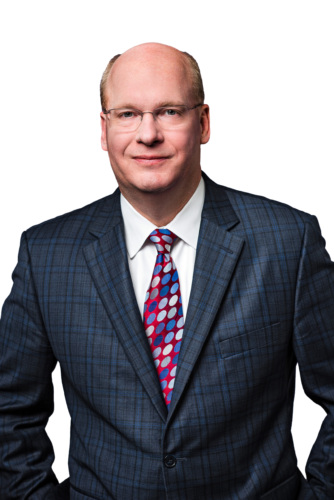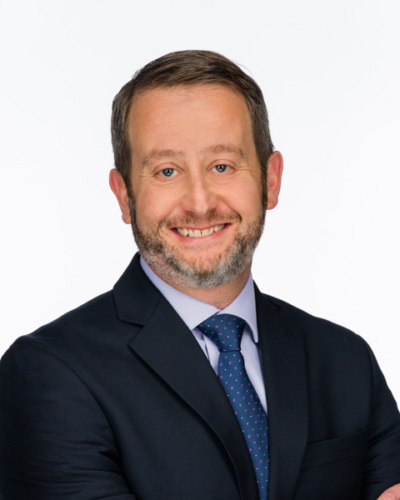
Mark Melamed
Deputy Vice President, Global Nuclear Policy Program
Geopolitical tensions, absence of dialogue, and emerging technologies are increasing the risk of nuclear and strategic miscalculation and conflict in the Euro-Atlantic region.
Test ideas, advance dialogue, and develop concrete proposals to reduce nuclear risk.
Global leaders refocus attention to reduce nuclear risks and strengthen security.
The Euro‑Atlantic Security Leadership Group (EASLG) is an independent, informal initiative that brings together leaders and experts to develop practical steps to reduce risks and strengthen security in the Euro-Atlantic region. The group includes approximately 50 former senior officials and experts from across the region. Lord Des Browne of Ladyton, Ambassador Wolfgang Ischinger, Secretary Ernest J. Moniz, Senator Sam Nunn, and Secretary Christine E. Wormuth are the co-convenors.
The EASLG develops concrete proposals and advances policy outcomes to reduce risk and strengthen security. Its work has refocused attention on nuclear risk reduction, strategic stability, and emerging threats, informing policy dialogue on cyber threats to nuclear systems, the importance of risk-reduction dialogue during crises, norms for space security and stability, upholding moratoria on nuclear testing, and promoting nuclear fail-safe reviews as a practical risk-reduction measure for all nuclear-armed states.
The Nuclear Threat Initiative (NTI) joined world leaders and policymakers at the 2026 Munich Security Conference (MSC), where NTI President and CEO Christine E. Wormuth and colleagues hosted events focused on reducing nuclear, biological, and emerging technology threats imperiling humanity.

Strengthening nuclear fail-safe measures and applying and adapting principles governing the use of outer space for peaceful purposes are essential to preventing nuclear use and maintaining strategic stability.
Statement by the Euro-Atlantic Security Leadership Group, Asia-Pacific Leadership Network, European Leadership Network, Grandview Institution, and Nuclear Threat Initiative
Statement by the Euro-Atlantic Security Leadership Group

Sixty-four former officials, military leaders, and experts call on nuclear-armed states in every region to take steps to reduce the risk of nuclear use.
Reducing and eliminating any nuclear risk that could lead to catastrophe is a common interest for all and an enduring responsibility for all nuclear-armed states.
NTI will join world leaders and policy makers at the 2025 Munich Security Conference (MSC) where NTI Co-Chair and CEO Ernest J. Moniz and colleagues will host multiple side events focused on reducing nuclear, biological, and emerging technology threats imperiling humanity.

The Nuclear Threat Initiative will be on the ground next week at the 2024 Munich Security Conference (MSC). Learn about all of NTI’s activities and official side events at MSC.

At this year's Munich Security Conference, NTI is hosting two official side events: one about the importance of global nuclear “fail-safe” measures and one about preventing bioweapons and catastrophic accidents.

EASLG leaders Des Browne, Wolfgang Ischinger, Igor Ivanov, Ernest J. Moniz, and Sam Nunn, along with 34 dignitaries from 12 countries, call for all nuclear-weapons states to conduct internal reviews of their nuclear command-and-control and weapons systems.
"Reducing and eliminating nuclear risks that could lead to catastrophic consequences is a common interest for all nations and an enduring responsibility of the nuclear weapon states."
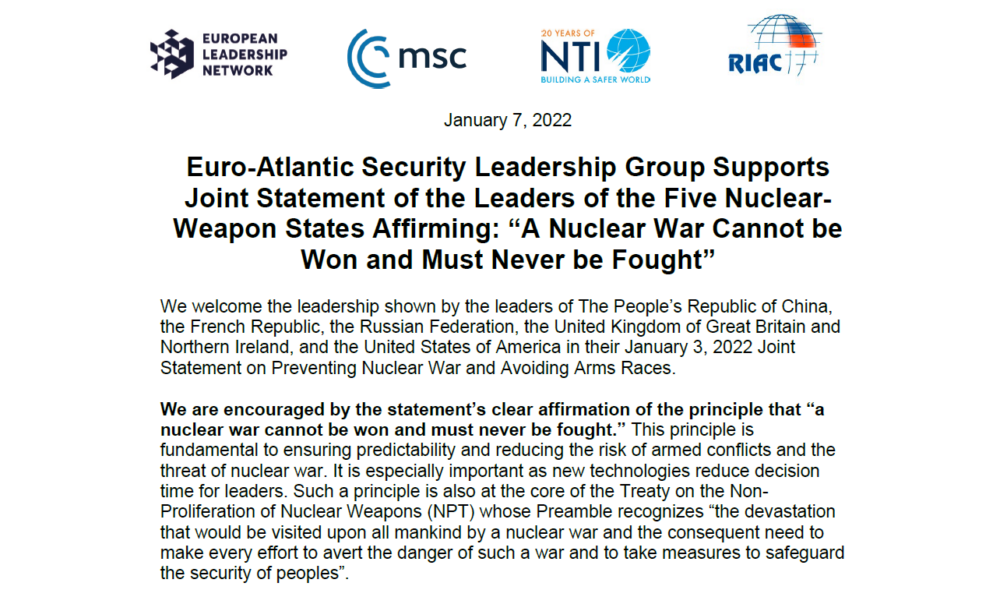
The Euro-Atlantic Security Leadership Group (EASLG) supports the Joint Statement of the Leaders of the Five Nuclear-Weapon States Affirming: “A Nuclear War Cannot be Won and Must Never be Fought”
Leadership Groups spanning the globe called on the Permanent Five members of the United Nations Security Council to jointly reaffirm the principle that “a nuclear war cannot be won and must never be fought.”
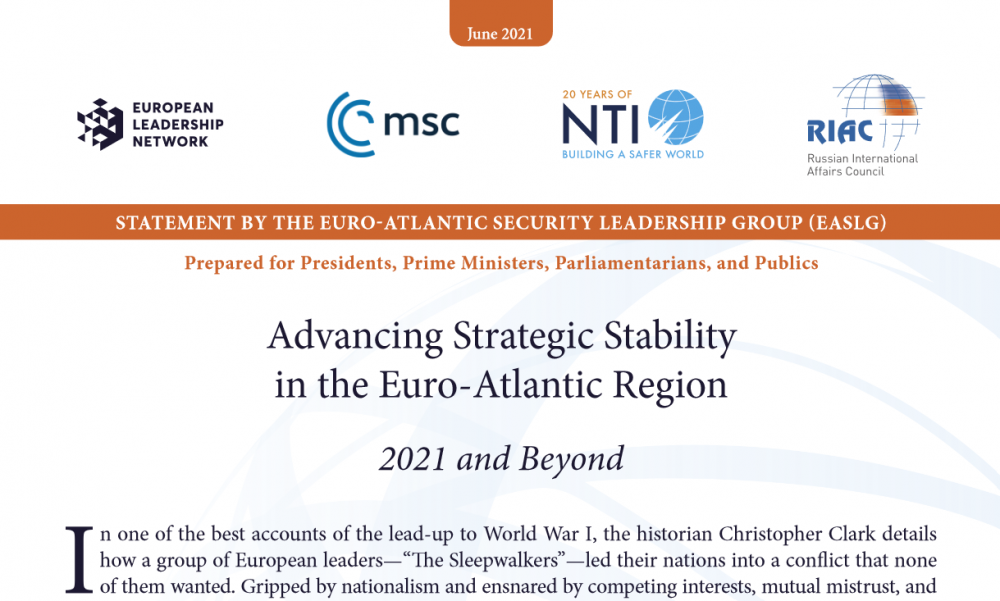
A statement with key recommendations for “Advancing Strategic Stability in the Euro-Atlantic Region, 2021 and Beyond.”
Nations in the Euro-Atlantic region must engage in dialogue to manage crises responsibly and build the trust necessary to address major security challenges.
The statement is the result of six months of intensive work within the EASLG on the issue of Ukraine and Euro-Atlantic Security
Browne, Ischinger, Ivanov and Nunn publish new op-ed; Statements from members of The Euro-Atlantic Security Leadership Group (EASLG).
The European Leadership Network has named Sir Adam Thomson KCMG as new director to replace Ian Kearns.
Sign up for regular updates on innovative, real-world solutions to existential threats.