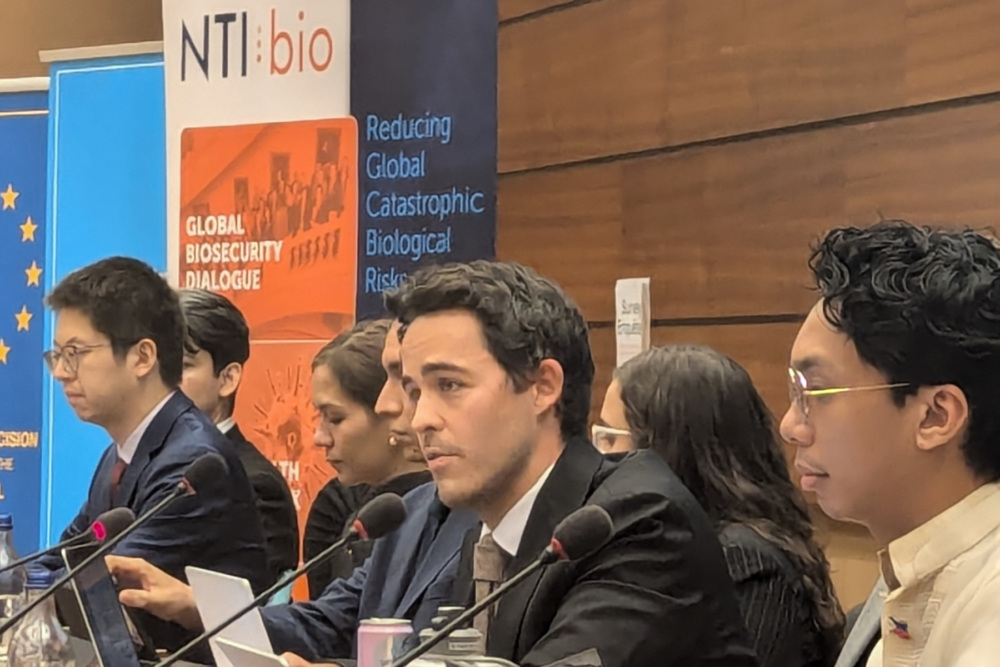
NTI | bio, in partnership with 80,000 Hours, CBWNet, the iGEM Foundation, the InterAcademy Partnership (IAP), the International Biosecurity and Biosafety Initiative for Science (IBBIS), the United Nations Office of Disarmament Affairs (UNODA), and Women of Color Advancing Peace, Security, and Conflict Transformation, is excited to announce the winners of the ninth annual Next Generation for Biosecurity Competition:
- Shreyash Borkar, University of Tübingen
Home country: India
- Sriram Kumar, University of Münster
Home country: India
- Kaitlyn Connors, Georgetown University
Home country: United States
Students and early-career professionals from 19 countries across five continents entered the 2025 competition. The challenge called for innovative papers on how to define “biological weapons” in today’s ever evolving biothreat landscape. An international panel of judges evaluated the papers and chose the winning team through a three-round process. A list of this year’s judges can be found below.
In their winning paper, Redefining Biological Weapons: Expanding the BWC to Incorporate Infrastructure Harm and Cyberbiothreats, the authors argue that the Biological Weapons Convention (BWC) must evolve to address emerging threats that target not only living organisms, but also critical infrastructure and digital systems. They propose policy recommendations to close oversight gaps, including expanding the definitions of biological agents and weapons to include material-degrading microbes and cyber-enabled biothreats; adopting a “functional harm” principle for oversight; integrating biosurveillance into infrastructure maintenance; strengthening cyber-biological infrastructure; and establishing an AI-powered threat forecasting platform to support proactive global biosecurity governance. They emphasize that implementing these recommendations will create needed safeguards to protect both living systems and critical infrastructure from 21st century biological risks.
Competition winners will receive travel support to attend the Working Group on the Strengthening of the Biological Weapons Convention in Geneva, Switzerland. They will present their paper during a UN Office of Disarmament Affairs (UNODA) and NTI side event, Diverse & Inclusive Engagement to Strengthen the Biological Weapons Convention on Friday, December 12th at 1:15PM – 2:45PM CEST.
In addition to the winning paper, the judges of this year’s competition also selected a runner-up from among the top-scoring papers. The authors of the runner-up paper are:
- Clement Bijl, The Netherlands Food and Consumer Product Safety Authority (NVWA)
Home country: Netherlands
- Yasmin Cürük, Charité – Universitätsmedizin Berlin
Home country: Germany
- Nina Ding, Charité – Universitätsmedizin Berlin
Home country: Germany
In their paper, The INTENT Framework: Operationalizing the BWC’s Definition Through Tiered Biosecurity Risk Assessment, the authors propose the INTENT Framework to address the challenges of verifying compliance with the Biological Weapons Convention’s (BWC) intent-based definitions of biological weapons amid evolving biotechnologies. The framework introduces four key indicators, Technical Risk, Executive Oversight, Negligence, and Transparency, to assess biosecurity risks in biological research and production facilities. By classifying facilities into four risk tiers, the framework allows for evidence-based evaluations without requiring proof of hostile intent. The authors emphasize that this approach through its tiered structure and focus on conduct, supports peaceful scientific innovation while enhancing global oversight and strengthening international biosecurity.
The Next Generation for Biosecurity Competition promotes the establishment of a global cross-sector cadre of early-career professionals dedicated to reducing catastrophic biological risks.
2025 Next Generation for Biosecurity Competition International Judges Panel
- Ms. Mayra AMENEIROS, Senior Fellow, IBBIS
- Ms. Katherine BUDESKI, PhD Candidate, Department of Epidemiology, Harvard T.H. Chan School of Public Health
- Dr. Nancy CONNELL, Professor Emerita, Rutgers University; Senior Scholar, NASEM Committee on International Security and Arms Control
- Dr. Barry DE VRIES, Postdoctoral Research Fellow, CBWNet, Justus-Liebig University Giessen
- Mr. Christopher EAST, Senior Fellow and Program Manager, The Council on Strategic Risks
- Mr. Jose GARZA-MARTINEZ, Researcher & Lecturer, Tecnologico de Monterrey
- Dr. Laura GONZALEZ SALMERON, Advisor, 80,000 Hours
- Prof. Aamer IKRAM, Chair Advisory Board, TEPHINET; Vice President, Int’l Associations of Public Health Institutes
- Mr. Christopher ISAAC, Director of Responsibility, iGEM
- Dr. Gregory KOBLENTZ, Director, Biodefense Program George Mason University
- Ms. Musonda MANDONA, Biosafety and Biosecurity Advisor, Ministry of Health Zambia
- Ms. Sandra MATINYI, Executive Director and Cofounder, Nuo Bioscience
- Dr. Piers MILLETT, Executive Director, IBBIS
- Ms. Shrestha RATH, Doctoral Student, Johns Hopkins Bloomberg School of Public Health
- Dr. Wasim SAJJAD, Assistant Professor of Microbiology, National University of Medical Sciences, Pakistan; Fulbright Scholar and Honorary Associate; Wisconsin Institute for Discovery, University of Wisconsin–Madison; Member IAP Biosecurity Working group
- Mr. Matthew SHEARER, Associate Scholar, Johns Hopkins Center for Health Security
- Ms. Eva SIEGMANN, Visiting Fellow, Council on Strategic Risks
- Dr. Claire STANDLEY, Senior Biosecurity Initiatives Lead, CEPI
- Mr. David STIEFEL, Director, NTI | bio
- Dr. Ralf TRAPP, International Disarmament Consultant, CBWNet
- Dr. Ashley TSENG, CDC Epidemic Intelligence Service Officer, Centers for Disease Control and Prevention, Hawaii State Department of Health