

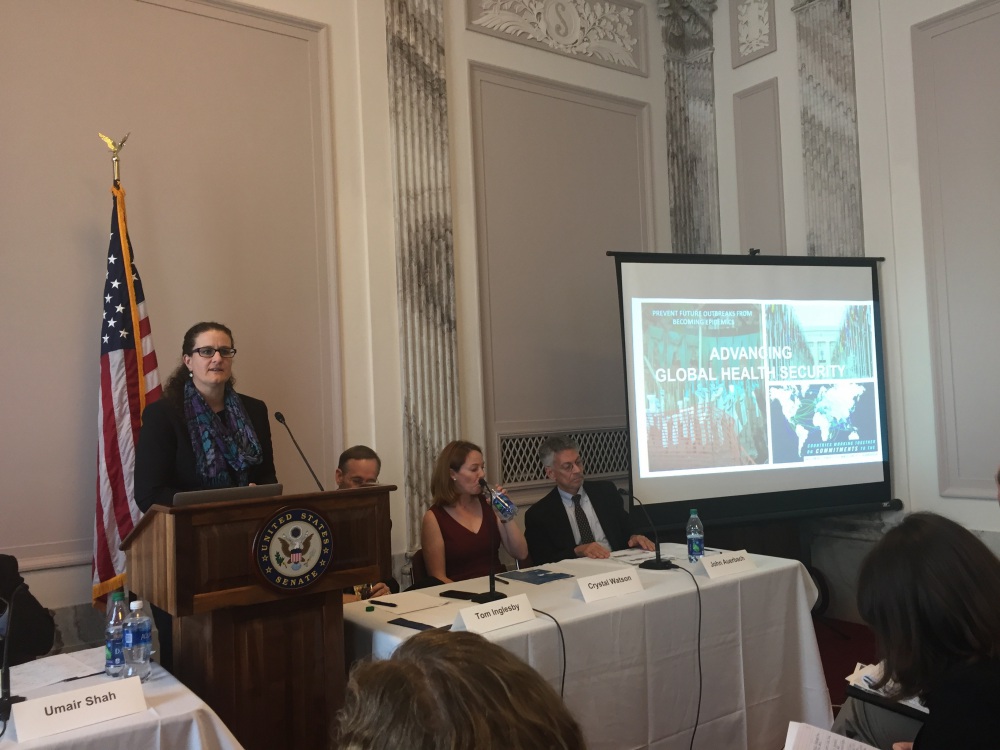
Some of the nation’s top health security experts delivered a
blunt message to lawmakers on Capitol Hill this week: It costs a lot less to
adequately fund prevention and preparedness programs up front than it does to
respond when a disease outbreak turns into a crisis.
“Investing in
preparedness before an emergency reduces the cost of response,” Paul Petersen,
director of the Emergency Preparedness Program at the State of Tennessee
Department of Health, said, noting that state and local public health
departments are uniquely positioned to respond first in the event of a crisis.
Peterson was joined at the congressional seminar by experts
from the Johns Hopkins Center for Health Security, other local public health
officials, and NTI’s senior director for global biological policy and programs,
Dr. Elizabeth (Beth) Cameron. The event was sponsored by Hopkins and the
non-profit, non-partisan Trust for America’s Health.
Crystal Watson, a senior associate at Johns Hopkins Center
for Health Security, said the administration’s proposed health security funding
levels for fiscal year 2018 represent a 9% overall reduction, including a 2%
reduction for radiological and nuclear security.
Local officials talked about what such reductions would mean
for their communities. “The challenges we have around West Nile Virus and Zika
have really been on our radar,” said Umair Shah, executive director of the Harris
County, Texas Public Health Department. He noted that a reduction in resources
does not lead to a reduction in the department’s responsibility to respond to
health security threats.
Beyond the United States, “every country in the world needs
to have a basic level of preparedness,” said NTI’s Cameron. “Epidemics,
whether intentional, accidental or naturally occurring can cost thousands to millions of lives
and billions of dollars. Prevention saves lives and averts political and
economic insecurity.”
The majority of the discussion addressed naturally occurring
(though still serious and deadly) outbreaks and epidemics, but Cameron reminded
the group that “the next epidemic could be caused by a bio-terrorist attack.”
The Nuclear Threat Initiative is working to help prevent
terrorists from acquiring material for weapons of mass destruction and
disruption, including bioweapons.
Learn more about our work on this issue, and other
biosecurity topics here.
Sign up for our newsletter to get the latest on nuclear and biological threats.
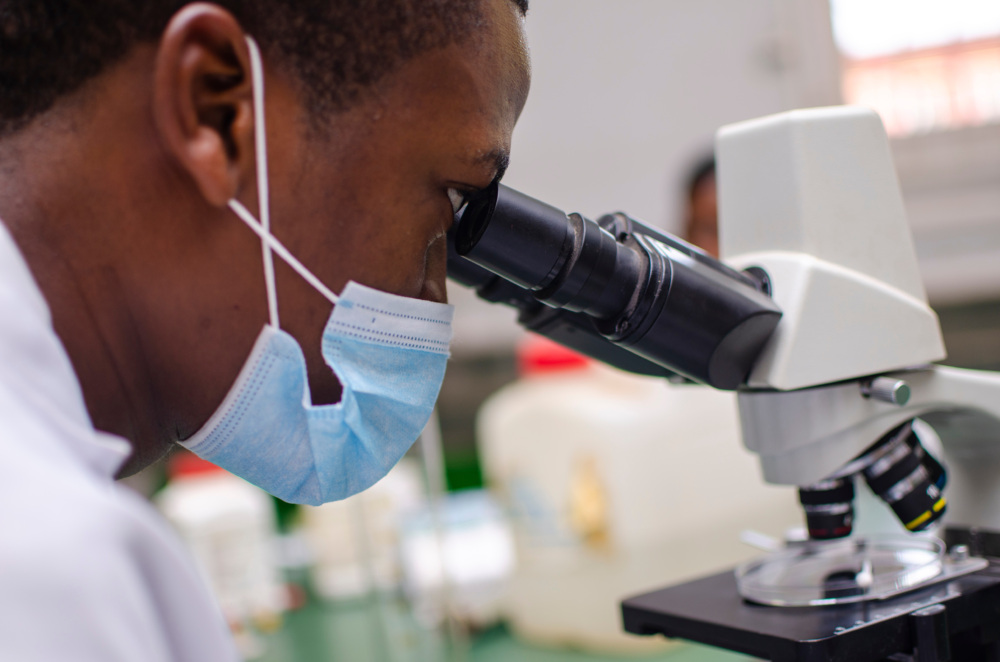
The AHS Index is an objective, evidence-based tool that helps countries and organizations set priorities and identify where investments can have the greatest impact. As health threats become more complex and interconnected, maintaining momentum will require sustained investment, stronger partnerships, and continued political commitment.
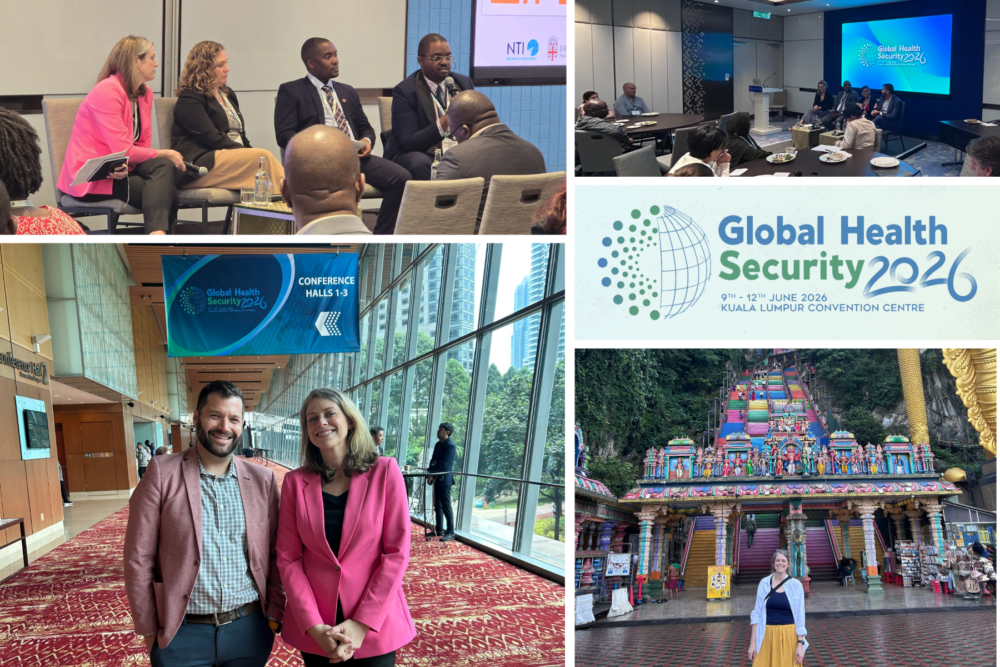
Multisectoral collaboration is a fundamental requirement for stronger health security.
As global resources become more constrained, evidence-based tools that guide investments toward maximum impact are more important than ever. This World Health Day, the WHO urges the world to embrace evidence, support science-led solutions, and advance global cooperation to turn evidence into action.
Sign up for regular updates on innovative, real-world solutions to existential threats.