
NTI-Led Delegation Advances U.S.-China Nuclear Fail-Safe Dialogue in Beijing
Former senior U.S. officials and NTI experts met Chinese counterparts to reduce the risk of accidental, mistaken, or unauthorized nuclear use.
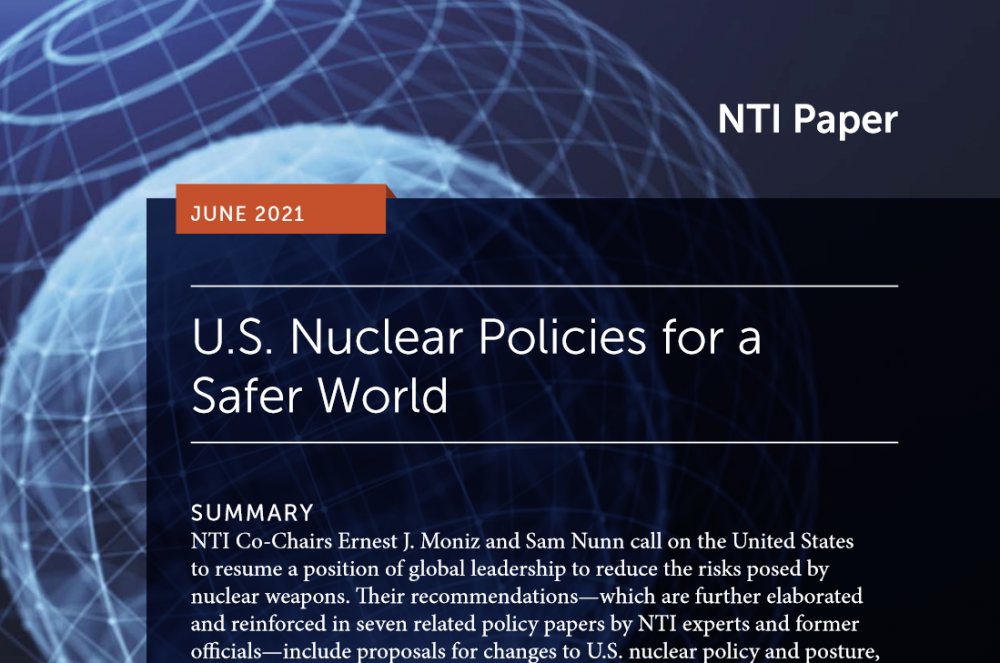
New papers outline recommendations for changes to U.S. nuclear policy and posture and engagement with Russia and China
Washington, D.C. – As President Biden arrives in Europe for key meetings with the G7, NATO, the European Union, and President Putin, NTI today is releasing U.S. Nuclear Policies for a Safer World. The set of papers, offered just as the administration begins its review of U.S. nuclear policies, posture and arms control, recommends changes to U.S. nuclear policy and posture, reengagement with Russia on strategic stability and arms control, dialogue and risk reduction efforts with China, and recommitment to multilateral efforts to strengthen the global nonproliferation regime.
NTI co-chairs Ernest J. Moniz and Sam Nunn urge the Biden administration to lead efforts to reduce growing nuclear risks. “The risk of use of a nuclear weapon is higher today than at any time since the Cuban Missile Crisis,” they write in an introduction to the papers. “Reducing these risks will require U.S. leadership and renewed commitment to diplomacy and engagement, bold and creative policy choices, and unwavering focus.”
Among other steps, Moniz and Nunn call for the establishment of a bipartisan liaison group between Congress and the administration. The purpose of this group would be to rebuild consensus supporting engagement and arms control as essential tools to reduce nuclear risks and advance U.S. national security. They also call for establishment of new policy guardrails to ensure that any decision to use nuclear weapons would be deliberative and based on appropriate planning and consultation, including with leaders in Congress.
In the accompanying papers, NTI experts Steve Andreasen, Lynn Rusten, Mark Melamed, and James McKeon make further recommendations.
On U.S. nuclear policy and posture to reduce the risk of use of nuclear weapons:
On reengagement with Russia on nuclear arms control and the full range of issues that affect strategic stability between the two sides:
On dialogue and risk-reduction efforts with China:
On strengthening the global nonproliferation regime:
Other NTI resources related to the Administration's meetings in Europe include our Atomic Pulse blog post on What is "Strategic Stability" and Why is it Important to U.S.-Russia Relations?, a virtual panel with NTI leaders and other experts on Recommendations to the U.S., Europe, and Russia, and the Euro-Atlantic Security Leadership Group (EASLG) statement on Advancing Strategic Stability in the Euro-Atlantic Region.
###
About the Nuclear Threat Initiative
The Nuclear Threat Initiative (NTI) is a nonprofit global security organization focused on reducing nuclear and biological threats imperiling humanity.
Sign up for our newsletter to get the latest on nuclear and biological threats.
Former senior U.S. officials and NTI experts met Chinese counterparts to reduce the risk of accidental, mistaken, or unauthorized nuclear use.
On November 3, the Nuclear Threat Initiative (NTI) and the Shanghai Institutes for International Studies (SIIS) convened U.S. and Chinese experts for a virtual workshop on reducing nuclear risks in the U.S.-China relationship.
New YouGov polling commissioned by NTI and ReThink Media finds that nearly 80 percent of registered voters, across party lines, say it is in the interest of U.S. national security to work with China to mitigate catastrophic threats associated with nuclear risks, AI development, and bioterrorism.
Sign up for regular updates on innovative, real-world solutions to existential threats.