Mary Olney Fulham
Director, Communications
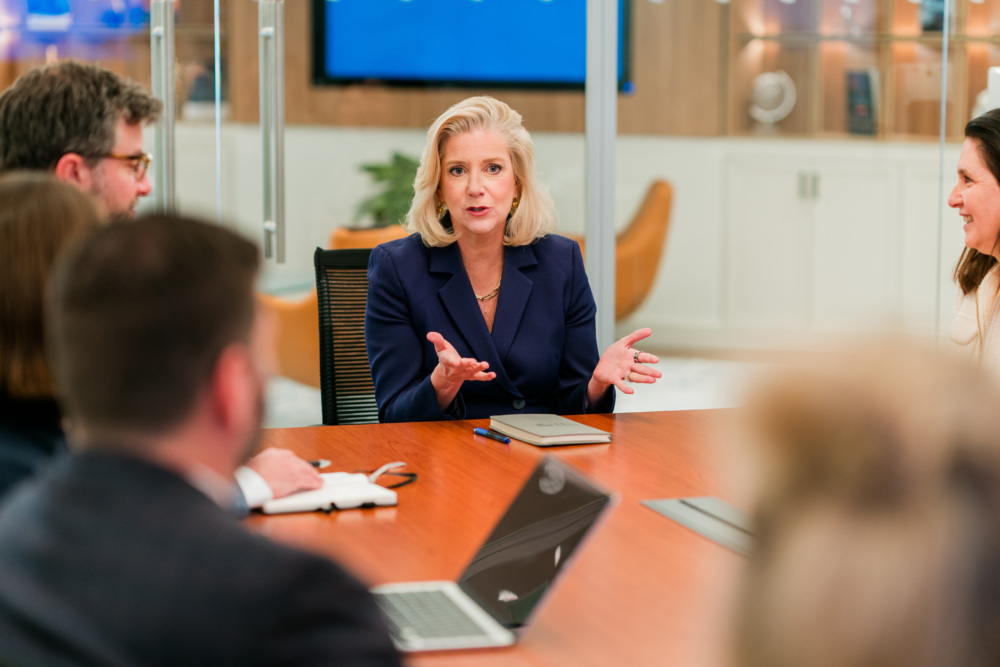
Christine E. Wormuth serves as the President and CEO of the Nuclear Threat Initiative. She joined NTI in November of 2025, having previously served U.S. Secretary of the Army during the Biden Administration and as Under Secretary of Defense for Policy in the Obama Administration. Christine spoke with Risky Business editors Mary Olney Fulham and Scott Nolan Smith about her role, vision for NTI, and her past experiences. This interview has been edited for length and clarity.
Growing up, my mom ran the English as a second language program at Texas A&M University, so I developed an interest in the wider world through the international students I met. We would talk about their cultures and governments, and the challenges they faced back home. There were moments when the geopolitical realities were impossible to ignore, like when the Iran hostage crisis happened—and suddenly the Iranian students were all sent away. These experiences were an early seed for my interest in international affairs.
I am also a child of the Cold War. I grew up hiding under my desk, doing drills for nuclear explosions … as if that would help. Then, during my junior year in college, I was in Paris when the Berlin Wall came down. A couple years later, the Soviet Union collapsed. These incredibly consequential events happened at a formative time for me and really narrowed my interest to security.
 One lesson I’ve learned is to leverage existing processes. If you can hook a new idea to a process that a department already has in motion, you can often get that idea into the bloodstream much more easily.
When I was at the Center for Strategic and International Studies, I developed a proposal to reshape how the military would respond to a crisis caused by a weapon of mass destruction here in the United States. A couple years later, I was fortunate to join the Obama administration as a political appointee and was part of the Department of Defense’s quadrennial defense review—a soup-to-nuts evaluation of strategy, programs, and budget. Homeland defense was up for consideration, so I held up my hand and said, “I have an idea!” I had found the right process to funnel my proposal into, and we actually got it implemented. I was quite psyched about that!
The landscape we face today — and the landscape NTI will face for years to come — looks very different from the last 25 years. When NTI was founded, and during its early years, the potential for cooperation and risk reduction was at a relative historic high. The Soviet Union had collapsed, and Russia, China and the United States were cooperating around issues such as counterterrorism and nuclear materials security.
Today we are in a much more fraught geopolitical era, where threats of all kinds are growing, and examples of government-led risk reduction are few and far between. But the fact that conditions have become more challenging makes NTI’s work even more important and necessary. As a non-profit, we can do things governments can’t always do, like hold unofficial talks with Chinese experts about nuclear threats and biosecurity, even when official channels have gone quiet.
 NTI can bring together industry, academia, and policy experts to figure out how to build guardrails around artificial intelligence capabilities that could make it easier for a bad actor to develop a dangerous pathogen. We can work with experts across Africa to build an index of African countries’ public health capacity that can help guide efforts to determine how best to invest future funds in national health systems. NTI can advise state governments and foreign governments on which designs for new nuclear power plants are least likely to create new proliferation challenges, which will help the United States and the world scale up nuclear power safely and securely.
Every single day NTI is doing everything it can to reduce nuclear, biological, and emerging technology threats — and ensure the peaceful applications of these technologies are harnessed for good. Every bit of progress, whether big or small, makes the world safer.
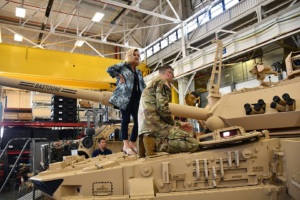 When I started, of course I knew I was the first woman to hold the job, but it wasn’t something I wanted to make much of. The longer I was in the role, the clearer it became that even though it wasn’t something I was too focused on, it was still going to shape my experience. Women only make up about 19 percent of the U.S. Army, and there are very few women in senior military leadership. Many of the generals I found myself leading had never had a woman as their peer, let alone their boss. Learning how to work together was an adjustment for us all, and some days were easier than others.
But what has stuck with me the most is how every time I visited an installation women soldiers and officers would come up to me, excited to talk and ask questions. I was always moved by how motivating it was for them to just see a woman in a leadership role, and how it helped them see their own potential. The saying is true: “if you can see it, you can be it.” If the person leading the whole U.S. Army is a woman, then they could be in the Special Forces, or a 4-star general, or the sergeant major of the Army—whatever they want to be.
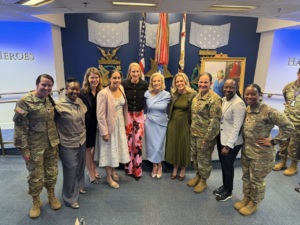 The U.S. Navy still has not had a woman as secretary. My advice to her is to be hypercompetent. There’s that old saying about how Ginger Rogers did everything Fred Astaire did except backwards and heels. It rings true for what is expected of women in military leadership roles.
I was by no means perfect, but in my first six months, I worked above and beyond to prove to the generals that I was smart, and I was not intimidated by them. I would push and make a lot of decisions, but I’d also listen. They had to see all of that to trust me.
I was also fortunate to have a group of incredible women on my staff—all West Point graduates—who I had a close, trusting relationship with. Although we were doing different jobs at different levels, we faced a lot of the same challenges every day—we all felt the pressure to be Ginger Rogers. But we kept each other motivated to keep going because we believed that women deserve to serve in the U.S. military, from combat roles to leadership. That should not be a question anymore.
I’ve gotten a lot of good advice over my career, but a few pieces have stuck with me.
First, “know your brief,” meaning be credible and competent on your portfolio. It’s good advice for anyone, but I think it’s particularly relevant for women in the national security community who sometimes face additional skepticism.
 Second, the person who is your intern today could be your boss tomorrow, so treat everyone with respect. This has proven true time and again.
Third, “don’t let the turkeys get you down.” Very early in my career, I was complaining to a mentor about a colleague who I saw getting ahead on connections rather than merit. My mentor told me that if I let every “turkey” in Washington get under my skin, I wouldn’t survive here. They were right—you must tune out the noise.
Finally, at the end of the day, take care of your reputation. It’s your calling card, and it follows you: how you treat people, how you work. If you have a good reputation, you can go very far. If you step on other people to get ahead, eventually, it will catch up with you.
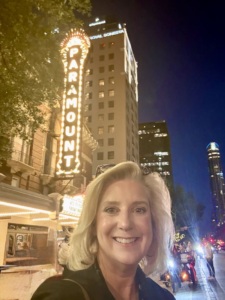
Yes! I just finished the last season of The Handmaid’s Tale—I was a bit behind—and it was awesome. Before that I watched Widow’s Bay, which I highly recommend. I’m proud to say that I was watching it before all the Emmy buzz! Now I’m waiting to see the next season of Silo and, of course, for a new Taylor Swift album eventually.
And for other interests, I love to paint. I double majored in political science and studio art in college. When my daughters were born, I painted a 360-degree mural in their bedroom with jungle scenes and an underwater world. It’s something I wish I had more time to do!
Sign up for our newsletter to get the latest on nuclear and biological threats.
Unlike past technological disruptions to global security which were driven by governments, market forces and business dominate today’s global innovation space. This includes working not only with thought leaders, but the doers that affect change. The latest FutureSafe Innovation Forum welcomed Dr. Kimberly Budil, Director of Lawrence Livermore National Laboratory, to discuss the future of national security science.

As AI expands what is possible in biology, it’s past time the biosecurity, insurance, and legal communities came together to examine what these developments mean for preventing harm and assigning responsibility if it occurs.
The development of SynthID Bio by a major frontier AI lab is an important reminder that responsible development and cutting-edge progress are not mutually exclusive.
Sign up for regular updates on innovative, real-world solutions to existential threats.