
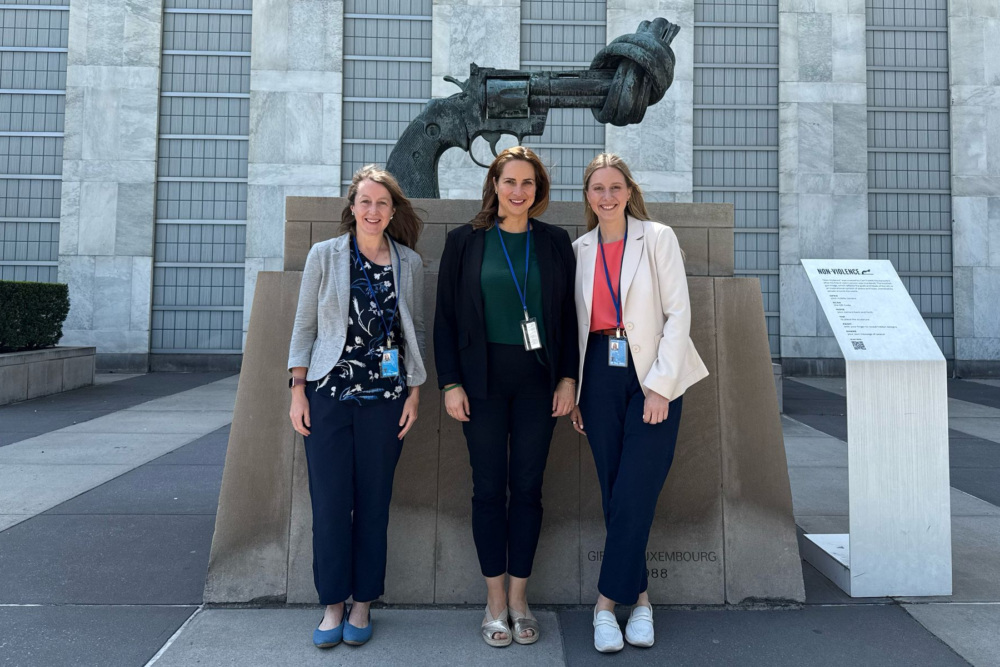
Isabelle Williams serves as a senior director at NTI. She leads and supports projects across NTI, including understanding nuclear effects and advancing a vision of a world free of nuclear weapons. She also supports NTI-wide implementation of institutional objectives and strategic priorities. She joined NTI in 2007 and previously held roles with various NGOs.
Isabelle spoke with NTI intern Siri Beck-Friis about her work, background, and lazy hobbies. This interview has been edited for length and clarity.
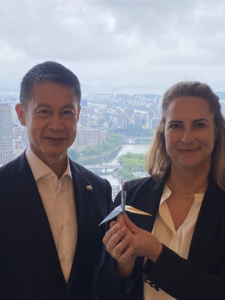 Let’s get straight into it: Tell me a bit about what you do here at NTI. What is keeping you busy at the moment?
So, my job is divided into several parts. One part of my work is supporting the Global Nuclear Policy Program. I’m currently working on a project to better understand the cascading effects of nuclear weapons in today’s interconnected world. What’s at stake if nuclear deterrence fails, and one – or several – nuclear weapons are used? While the immediate blast effects are relatively well understood, far less is known about the longer-term consequences — particularly their effects on economies and societies in today’s globalized world.
Another part of my work focuses on a project to advance a credible vision of a future free of nuclear weapons. We are looking beyond the horizon to ask questions relating to whether a world without nuclear weapons is feasible, and what kinds of structures and tools will be required to sustain it? We are currently working with a really smart group of experts to design the verification system needed in a world without nuclear weapons.
The last part of my work focuses on supporting processes to review and implement NTI-wide strategic priorities.
That sounds like a full plate! In today’s geopolitical environment, what’s the most challenging aspect of envisaging a world without nuclear weapons?
Well, times are difficult right now to make progress on nuclear risk reduction, let alone on disarmament—especially given geopolitical tensions and governments increasingly relying on these weapons. But if we believe nuclear risks are increasing then there is also a chance that at some point nuclear weapons will be used.
In addition to promoting concrete actions by governments to reduce risks, we’re also exploring what an alternative future without nuclear weapons would look like.
We’re exploring questions like what would be required in terms of verification, enforcement, institutions, and so on? What already exists and where are there significant gaps? Then, we work backwards from that and ask: How do we get to that future from where we are right now and are there things that would apply today? It’s a quite creative, problem-solving approach. Things might be challenging right now but given the consequences of nuclear war it’s important to explore alternative paths to the one we’re currently on.
 Switching gears a little: I know you’ve held multiple roles in the arms control field before coming to NTI. What do you enjoy most about working at NTI?
The people! I love working with a good team that is passionate about what they do and our mission. I’m also really lucky to be part of an organization that approaches nuclear and biological issues with many different strategies and tactics to support our priorities. For example, we have a strong communications team—and now also a government relations team—which gives us a range of tools to influence debates and to promote lasting change.
And how did you first become interested in arms control and security issues?
It’s a funny story, actually. Growing up, my parents were both members of the Campaign for Nuclear Disarmament in the UK, and they would take me—or rather, drag me—to demonstrations in the 80’s. My father also worked on nuclear issues, and I’ve even found some of his old reports and pamphlets on nuclear effects. So, while I didn’t really appreciate the importance of nuclear issues as a kid, I guess I’ve come full circle!
It’s funny that you were almost forced to engage with nuclear issues as a child, and now here you are, working on nuclear issues many years later!
Yes! I think I always knew I wanted to be in mission-driven work on issues that I care about. After studying international relations in the UK, I ended up working with an expert in arms control who had been an United Nations Special Commission (UNSCOM) inspector in Iraq, that focused me on the nuclear world.
 I’m also curious to know how you ended up here in DC, having grown up and studied in the United Kingdom?
I originally came here years ago to set up a U.S. office of the International Institute for Strategic Studies. I liked DC—it’s green, spacious, and livable—and felt like an exciting move at the time. I got a job with a small non-profit here and ended up meeting my husband and having my two boys. It’s always been important to me to also stay closely connected to the UK as my family are all back there, so I’m fortunate to be able to travel back regularly and enjoy my London life too!
Working on nuclear weapons issues can be exhausting. What do you do to recharge and keep your sanity?
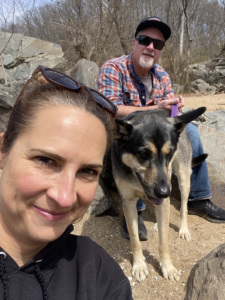
I walk my dog, listen to podcasts, and go for hikes. I also love reading, going out to see bands, and watching mysteries on Netflix. Mainly just lazy hobbies! I also love visiting art galleries.
I love lazy hobbies, too! Do you have any recommendations on books to read or TV shows to watch? Do you have a favorite book?
I just rewatched Fleabag which is really good, and it hit me more deeply when I watched it the second time around. I also love The Great British Bake Off, nature documentaries, and recently got in to The Traitors – it’s very addictive!
As for books, I read so much that it changes all the time! One book that always stands out is The Overstory by Richard Powers. It tells nine different stories where trees are at the center of the narrative. A few books that I read recently that I loved are Demon Copperhead by Barbara Kingsland, Heart, Be at Peace by Donal Ryan, and Grace by Paul Lynch. Oh, I wish this blog could just be me listing the books I love!
Great idea, maybe we will have to do a spin-off blog series featuring your top book picks! Thanks so much for the book recommendations and for sharing the important work you’re doing to make the world a safer place.
Sign up for our newsletter to get the latest on nuclear and biological threats.

The integration of AI into nuclear systems is underway. The guardrails, safety, and security frameworks needed to understand and manage the consequences are not. A new generation of AI-informed nuclear fail-safe reviews is urgently needed in all countries with nuclear weapons.

Most of us think of cognitive biases as quirks of everyday decision-making, but a recent Texas National Security Review study shows they are deeply embedded in people’s attitudes toward nuclear weapons and war.
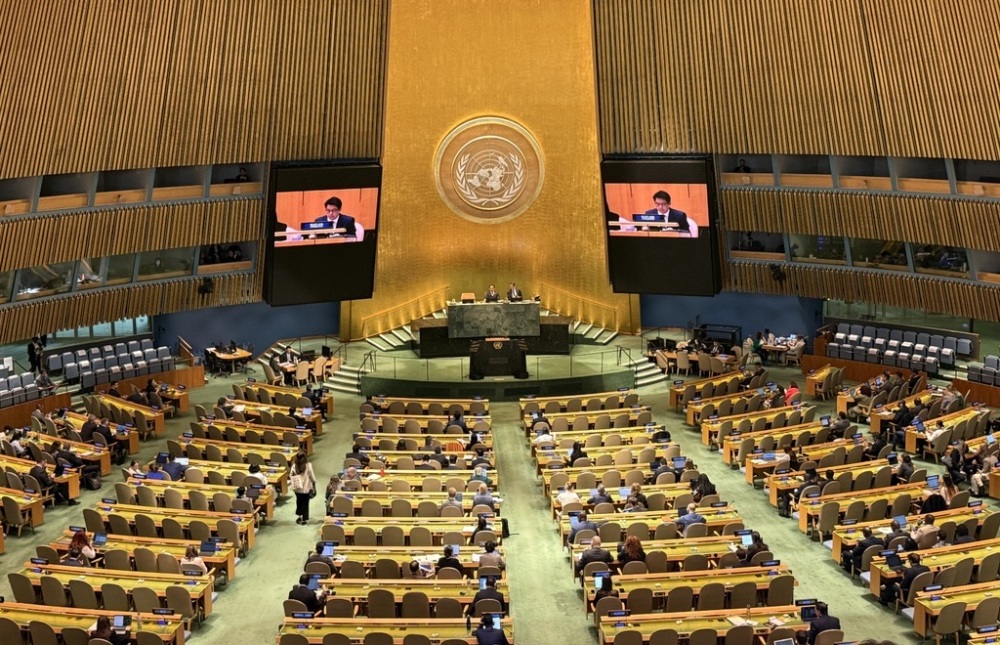
After four weeks of intense negotiations, it is entirely understandable to feel frustration, disappointment, and anger. What we cannot afford is for diplomats, policymakers, and publics to internalize that frustration as resignation.
Sign up for regular updates on innovative, real-world solutions to existential threats.