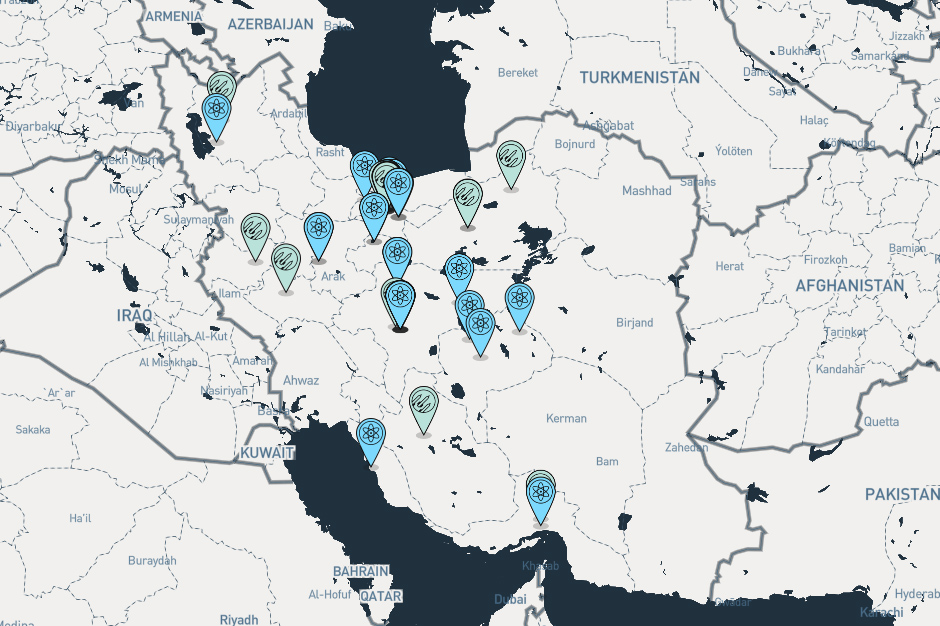
Minimizing Weapons-Usable Nuclear Material: A Nuclear Security Success Story Still in Progress
One of the most significant achievements in reducing the risk of nuclear terrorism over the past two decades is something that rarely makes headlines.
Here we highlight the work of NTI and share knowledge, ideas, and viewpoints addressing the crosscutting challenges our world faces—addressing risks while supporting innovation—to make our world safer.
One of the most significant achievements in reducing the risk of nuclear terrorism over the past two decades is something that rarely makes headlines.
Sign up for our newsletter to get the latest on nuclear and biological threats.
Strengthening nuclear fail-safe measures and applying and adapting principles governing the use of outer space for peaceful purposes are essential to preventing nuclear use and maintaining strategic stability.
Life science research moves quickly. But not all research carries the same level or type of risk. For funders, the challenge is to identify risks early—without slowing critical research. And now there's a straightforward tool to help address this.
Cassandra Varanka is NTI’s director of legislative affairs. Since joining NTI in July 2025, she has focused on developing and advancing legislative strategies to shape impactful policy outcomes that further the organization’s agenda in the U.S. government.
In a political climate that feels more divided than ever, it seems nearly impossible to agree on anything—except, as it turns out, arms control. A YouGov poll commissioned by NTI and ReThink Media found that 91 percent of Americans support capping U.S. and Russian nuclear arsenals, including 89 percent of Trump voters.
Global health security —the ability to protect against the negative impacts of disease outbreaks — is too important to be left solely to the public sector. Industry has a vital interest in helping countries better prepare for future epidemics and pandemics.
Mirror life operates outside the assumptions that underpin modern biosafety, biosecurity, and medical surveillance, meaning the policy challenge is not only what to regulate — but how to govern a technology that doesn’t yet exist.
Aigerim Seitenova is a human rights professional and nuclear justice advocate from Kazakhstan. A third-generation survivor of Soviet nuclear testing in Semipalatinsk, she co-founded the Qazaq Nuclear Frontline Coalition and produced the documentary JARA – Radioactive Patriarchy: Women of Qazaqstan.
What does it take to reveal truth in the face of censorship? A fascinating new PBS documentary, Bombshell, tells the story of the U.S. government’s efforts to cover up the impact of the 1945 atomic bombings of Hiroshima and Nagasaki, and the journalists who witnessed the devastation and spoke up.
The way we talk about risk shapes what gets done and who plays a role. Hugh Sullivan, NTI’s vice president for development explores how storytelling, tailored messaging, and a focus on agency can turn risk into action—and why optimism is essential for impact in global security.
You might not expect a man in yellow tights eating syrupy spaghetti to teach you about global health security—but Elf offers surprisingly helpful lessons to understand the importance of addressing biological threats before they become global pandemics.
Senior Director, Communications
Director, Communications
Sign up for regular updates on innovative, real-world solutions to existential threats.
{ location = 'https://www.nti.org/get-updates/' }, 300);">Get Updates