
About the image
Overview
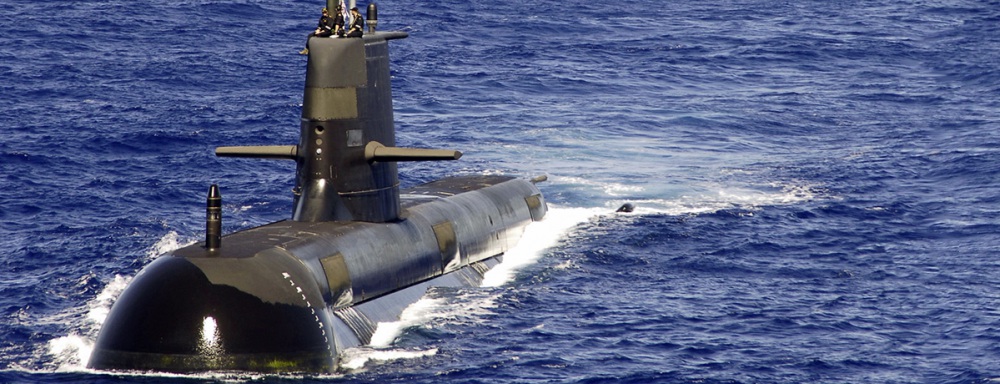
The Royal Australian Navy (RAN) currently operates six diesel-electric Collins-class submarines, which are based at Fleet Base West, HMAS Stirling, south of Perth in Western Australia.1 The Department of Defence plans to build at least eight nuclear submarines by 2040 as well as a new submarine base on the east coast.2
As part of the AUKUS agreement made in 2021, Australia expects to follow an Optimal Pathway to enhance its nuclear-powered attack submarine capabilities (SSNs). This involves expanding industrial capacities to produce SSNs, along with the increased undersea presence in the Indo-Pacific region.3 Australia plans to collaborate with the United Kingdom and United States to reach these goals.
Capabilities at a Glance
Total Submarines in Fleet: 6
- Ballistic missile submarine (SSBNs): 0
- Nuclear-powered attack submarines (SSNs): 0
- Diesel-electric attack submarines (SSKs): 6
- Air-independent propulsion (AIP) enabled: 0/6
Submarines
History
In 1982, the Australian government approved a plan to replace its aging Oberon-class submarines. The Australian government emphasized domestic construction for the project — including the use of local contractors — in order to facilitate significant technology transfer. In 1987 the Australian government chose the Australian Submarine Corporation Pty Limited (ASC), a company founded by Swedish shipyard Kockums and Australian partners, to build the six Collins-class submarines. As a result of this domestic construction, Australia gained the industrial capacity to build, service, and modernize submarines indigenously.4
The current fleet of Collins-class vessels are based on the Kockums Type 471 design. The oldest submarine in the Australian fleet, the HMAS Collins, was constructed in 1990 and commissioned in 1996. The remaining five Collins-class submarines were commissioned over the following seven years.5
In September 2021, Australia signed a trilateral agreement with the United Kingdom and United States to establish AUKUS. This security agreement focuses on providing a nuclear-powered, conventionally armed submarine force for Australia by the 2040s.6 After announcing this agreement, the three states entered a consultation to determine the optimal path to reach their goals, which was announced in March 2023.7
The Australian Submarine Agency (ASA) was established in July 2023 to help enact the SSN program via AUKUS.8
Modernization and Current Capabilities
In a 2009 Defence White Paper, the Australian government announced its intent to replace the fleet of Collins submarines with twelve 4000-ton long-range Attack-class submarines by 2030. 9 In 2016, the Australian government selected the French company Naval Group to build the Attack-class submarines and in February 2019 finalized the $50 billion contract. In 2009, 2013, and 2016 White Papers, the Department of Defence stated that Australia had no incentive to develop nuclear-capable submarines as the “nuclear and conventional military capabilities of the United States can offer effective deterrence.”10
Australian policy makers became upset by cost overruns, delays, and exclusion of Australian shipyards from the Attack-class building program. In September 2021, the Australian government abruptly canceled its contract with Naval Group and announced a joint partnership with the United States and United Kingdom (known as AUKUS) to build at least eight nuclear-powered submarines in Australia.11 In early 2023, the members of the AUKUS agreement announced a several-step process to build Australia’s domestic submarine program over the next decades. Pending Congressional approval, the U.S. will sell 3-5 Virginia Class nuclear submarines to RAN beginning in the 2030s.12 To support the additional submarines, RAN will construct a naval base on the east coast in either Newcastle, Port Kembla, or Brisbane. In addition, more than $993 million was earmarked by the Australian government to prepare a naval base in Western Australia for nuclear submarines.13
Ship Biographies
Collins-Class (Type 417)
Australia possesses six Collins-class diesel-electric attack submarines. These submarines are 77.8 meters long with a 7.8-meter-wide beam and can travel up to 20 knots when submerged. They can remain submerged for about 70 days without surfacing and are armed with six 533mm torpedo tubes. They also carry Harpoon anti-ship missiles and can substitute mines for their torpedo arsenals.14
Virginia-Class
These submarines are 114.8 meters long (140.5 meters with VPM, or Virginia Payload Module) with a 10.36-meter beam and can travel 25+ knots. Since they are nuclear submarines, they can remain submerged for up to three months at a time.15 They can carry Tomahawk missiles and Mk 48 ADCAP torpedoes.16
Import and Export Behavior
Imports
In May 2016 the Australian government ordered twelve submarines from France; the submarines would have been built locally by ASC to replace the existing Collins-class submarines employed by RAN.17 The nuclear submarines planned under the AUKUS deal will be built by ASC in Adelaide with technical assistance from the United States and United Kingdom.18
In 2021, Australia broke a contract with France which would have provided a dozen diesel-powered submarines. Australia provided 555 million euros as compensation to France for ending the deal.19
Instead of importing submarines from France, Australia has turned to the AUKUS alliance for imports. Nuclear reactors will be produced in the U.K. before getting imported and added onto submarine vessels produced in Adelaide, South Australia.20 Australia is expected to import 3-5 Virginia-class submarines from the U.S. by the 2030s.21 While comments made by the Trump Administration in early 2025 raised concerns about the continued reliability of AUKUS commitments, defense officials in both countries have spoken on the strategic importance of continued AUKUS commitment. 22
Exports
Although in the 1990s the Australian Submarine Corporation expressed interest in exporting submarines to Asian countries such as Indonesia, Malaysia, Japan, Thailand, and Singapore, Australia is not currently a submarine exporter.23
Explore the Collection
Your are currently on
Australia Submarine Capabilities
Brazil Submarine Capabilities
Chile Submarine Capabilities
China Submarine Capabilities
France Submarine Capabilities
Germany Submarine Capabilities
Greece Submarine Capabilities
India Submarine Capabilities
Indonesia Submarine Capabilities
Iran Submarine Capabilities
Israel Submarine Capabilities
Italy Submarine Capabilities
Japan Submarine Capabilities
Malaysia Submarine Capabilities
Netherlands Submarine Capabilities
North Korea Submarine Capabilities
Pakistan Submarine Capabilities
Russia Submarine Capabilities
Singapore Submarine Capabilities
South Korea Submarine Capabilities
Sweden Submarine Capabilities
Taiwan Submarine Capabilities
United States Submarine Capabilities
Submarine Detection and Monitoring: Open-Source Tools and Technologies
Stay Informed
Sign up for our newsletter to get the latest on nuclear and biological threats.
More on
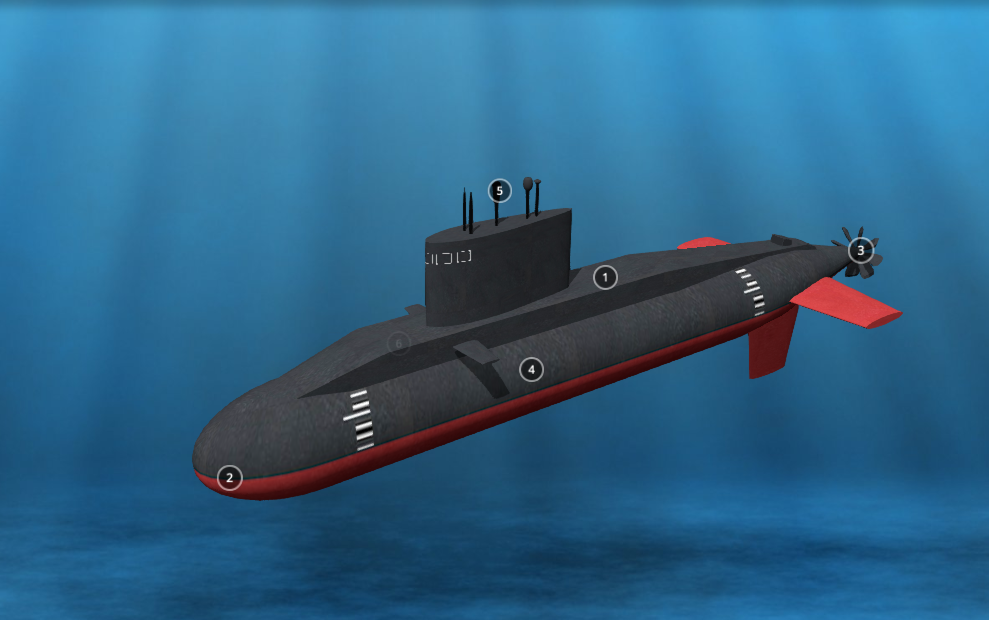
Submarine Detection and Monitoring: Open-Source Tools and Technologies
Using tools like commercial satellite imagery, radar, sensors, and media analysis, we can understand fleet details, construction, and potentially patrol patterns and behaviors.
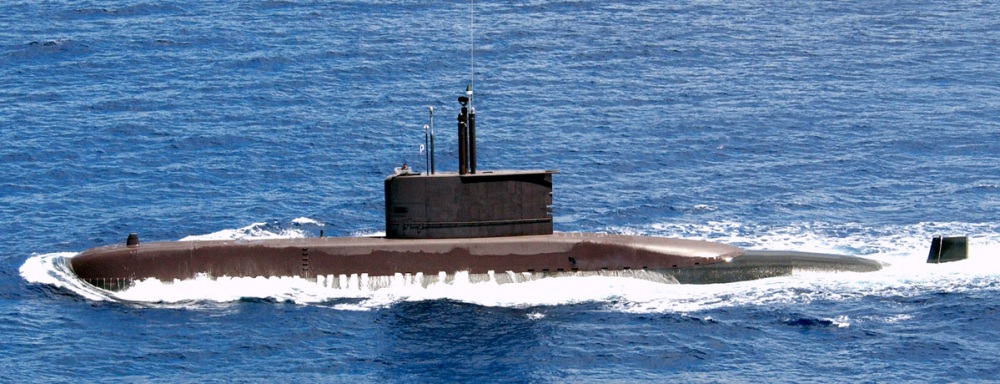
Indonesia Submarine Capabilities
The Indonesian Navy, also known as Tentara Nasional Indonesia-Angkatan Laut (TNI-AL), operates two classes of submarines: The older Cakra-class Type 209/1300 vessels and the Nagapasa-class Type 209/1400 vessels.
Brazil Submarine Capabilities
Global trends in the sale and acquisition of diesel- and nuclear-powered submarines by country with capabilities, imports and exports. (CNS)
Glossary
- Diesel-electric submarine (SSK)
- Diesel-electric submarine: A submarine with a diesel-electric transmission. Diesel-electric transmissions require access to oxygen for the diesel generator to charge the submarine’s batteries or drive the motor. This type of submarine is thus louder and must surface more frequently than a nuclear-powered submarine. A diesel-electric submarine can fire conventional cruise missiles against land targets, and in theory, can also carry nuclear-tipped cruise missiles. Diesel-electric submarines are significantly cheaper to build and purchase than nuclear-powered vessels, which makes them the vessel of choice for smaller navies.
- SSBN
- Ship, Submersible, Ballistic, Nuclear: A hull classification for a submarine capable of launching a ballistic missile. The "N", or nuclear, refers to the ship's propulsion system. SSBN's are generally reserved for strategic vessels, as most submarine launched ballistic missiles carry nuclear payloads. A non-strategic vessel carries the designation SSN, or attack submarine.
- Diesel-electric submarine (SSK)
- Diesel-electric submarine: A submarine with a diesel-electric transmission. Diesel-electric transmissions require access to oxygen for the diesel generator to charge the submarine’s batteries or drive the motor. This type of submarine is thus louder and must surface more frequently than a nuclear-powered submarine. A diesel-electric submarine can fire conventional cruise missiles against land targets, and in theory, can also carry nuclear-tipped cruise missiles. Diesel-electric submarines are significantly cheaper to build and purchase than nuclear-powered vessels, which makes them the vessel of choice for smaller navies.
- Air Independent Propulsion Technology (AIP)
- Air Independent Propulsion Technology (AIP): A propulsion system that uses liquid (or compressed) oxygen or hydrogen fuel cells, thereby allowing submarines to stay submerged for longer periods without the need for external sources of oxygen. This increased endurance also increases a submarine’s survivability.
- Deterrence
- The actions of a state or group of states to dissuade a potential adversary from initiating an attack or conflict through the credible threat of retaliation. To be effective, a deterrence strategy should demonstrate to an adversary that the costs of an attack would outweigh any potential gains. See entries for Extended deterrence and nuclear deterrence.
Sources
- “Guided Missile Submarine, Diesel-Electric (SSG),” Royal Australian Navy, www.navy.gov.au.
- Ewen Levick, “No End to Questions as Australia Chooses Nuclear Submarines,” Australian Defence Magazine, September 17, 2021, www.australiandefence.com.au; and Anthony Galloway, “Expect Submarine Delays, Marles Says, as He Plans for Defence Capability Gap,” Sydney Morning Herald, June 6, 2022, www.smh.com.au; and Marcus Hellyer, “Unpacking the (Semi-)Announcement of a Submarine Base on Australia’s East Coast,” Australian Strategic Policy Institute, March 9, 2022, www.aspistrategist.org.au.
- “Optimal Pathway,” Australian Submarine Agency, www.asa.gov.au.
- Derek Wollner, “Procuring change: how Kockums was selected for the Collins class submarine,” Research paper No. 3, 2001-2002, Information and Research Services, Department of the Parliamentary Library, www.aph.gov.au.
- “Collins-Class Submarines,” ASC, www.asc.com.au.
- “AUKUS: The Trilateral Security Partnership between Australia, U.K., and U.S.,” U.S. Department of Defense, www.defense.gov.
- Jim Garamone, “U.S., Australian, British Land Chiefs Address Security Agreement’s Progress,” U.S. Department of Defense, 12 March 2023, www.defense.govs.
- Gordon Arthur, “Attack Submarines Dominate Record High $36.8B Australian Defense Budget,” U.S. Naval Institute News, 20 May 2024, https://news.usni.org.
- “Defending Australia in the Asia Pacific Century: Force 2030,” Australian Government Department of Defence, Defence White Paper 2009, www.defence.gov.au.
- Australia. Department of Defence, 2016 Defence White Paper.
- Zoya Sheftalovich, “Why Australia Wanted Out of Its French Submarine Deal,” Politico, September 16, 2021, www.politico.eu.
- “FACT SHEET: Trilateral Australia-UK-US Partnership on Nuclear-Powered Submarines,” The White House, March 13, 2023, www.whitehouse.gov.
- Lewis Jackson, “Australia earmarks billions for naval infrastructure as BAE wins AUKUS submarine work,” Reuters, March 21, 2024, www.reuters.com.
- “Collins-Class Submarines,” ASC, www.asc.com.au.
- https://hii.com/what-we-do/capabilities/submarines/
- “Attack Submarines - SSN > United States Navy > Display-FactFiles,” U.S. Navy, March 15, 2024, www.navy.mil.
- Minister for Defense Media Release, “Future Submarine Announcement,” Navy Daily, 26 April 2016, http://news.navy.gov.au.
- “Remarks by President Biden, Prime Minister Morrison of Australia, and Prime Minister Johnson of the United Kingdom Announcing the Creation of AUKUS,” The White House, September 15, 2021, www.whitehouse.gov.
- “Australia announces compensation deal with France for scrapped submarine contract,” France 24, 6 November 2022, www.france24.com.
- “Australia to Contribute $3bn for Construction of AUKUS Submarines,” Al Jazeera, 22 March 2024, www.aljazeera.com.
- Jennifer Parker, “One year along Australia’s optimal pathway to nuclear-powered submarines,” Australian Strategic Policy Institute, 13 March 2024, www.aspistrategist.org.au.
- Kirsty Needham, “US Starts to Build Submarine Presence on strategic Australian Coast Under AUKUS,” Reuters, March 17, 2025, www.reuters.com.
- David Lague, “Submarines Lift Export Hopes,” Sydney Morning Herald, 7 November 1994, www.lexisnexis.com.